TL;DR: Do Ho Suh’s solo retrospective runs at MMCA Seoul (National Museum of Modern and Contemporary Art) from August 27, 2026 to February 9, 2027. Admission is 8,000 KRW, with a 10% online discount always available and a 20% early-bird discount if you book before September 13, 2026. The museum runs timed one-hour entry slots, and you can book either through Naver or directly on MMCA’s own site — the museum’s own booking page tends to have more open slots than Naver.
If you’ve only ever seen Do Ho Suh’s translucent fabric houses in photos, this show is worth rearranging a Seoul itinerary for. It’s his first solo exhibition at MMCA under his own name, and most of the roughly 500 works on view — including two hundred-plus early drawings — are being shown in Korea for the first time.
Suh grew up in a traditional hanok house in Seongbuk-dong, Seoul, then spent decades living between Seoul, New York, London, and Berlin. “Home” — specifically, the house he grew up in — is the single idea he’s returned to across four decades of work, and this retrospective is the first time that whole arc, from student sketchbooks to recent large-scale installations, has been shown together in one place.
Quick info
- Where: MMCA Seoul, 30 Samcheong-ro, Jongno-gu, Seoul
- Dates: August 27, 2026 – February 9, 2027 (a related installation in the museum’s Seoul Box runs December 18, 2026 – March 28, 2027)
- Hours: Mon, Tue, Thu, Fri, Sun 10:00–18:00 / Wed, Sat 10:00–21:00
- Admission: 8,000 KRW — 10% off with online booking (any time), 20% off if you book by September 13, 2026
- Entry format: Timed one-hour entry slots (helps keep the galleries from getting too crowded)
- Parking: Available on-site (paid)
Book directly through MMCA, not just Naver
If you’re booking as a tourist, book through MMCA’s own English-language ticketing page rather than assuming Naver Reservation (네이버 예약) is your only option — Naver is the default booking channel for Korean visitors, so its slots fill up fast, while the museum’s own site regularly has more open time slots for the same day. Worth checking both if your preferred hour is sold out on one.
Because entry is capped by hourly slots, you don’t need to line up outside — just show up close to your booked time. The queue for walk-ins (people without a reservation) was noticeably long when I visited, so booking ahead is worth the five minutes it takes.
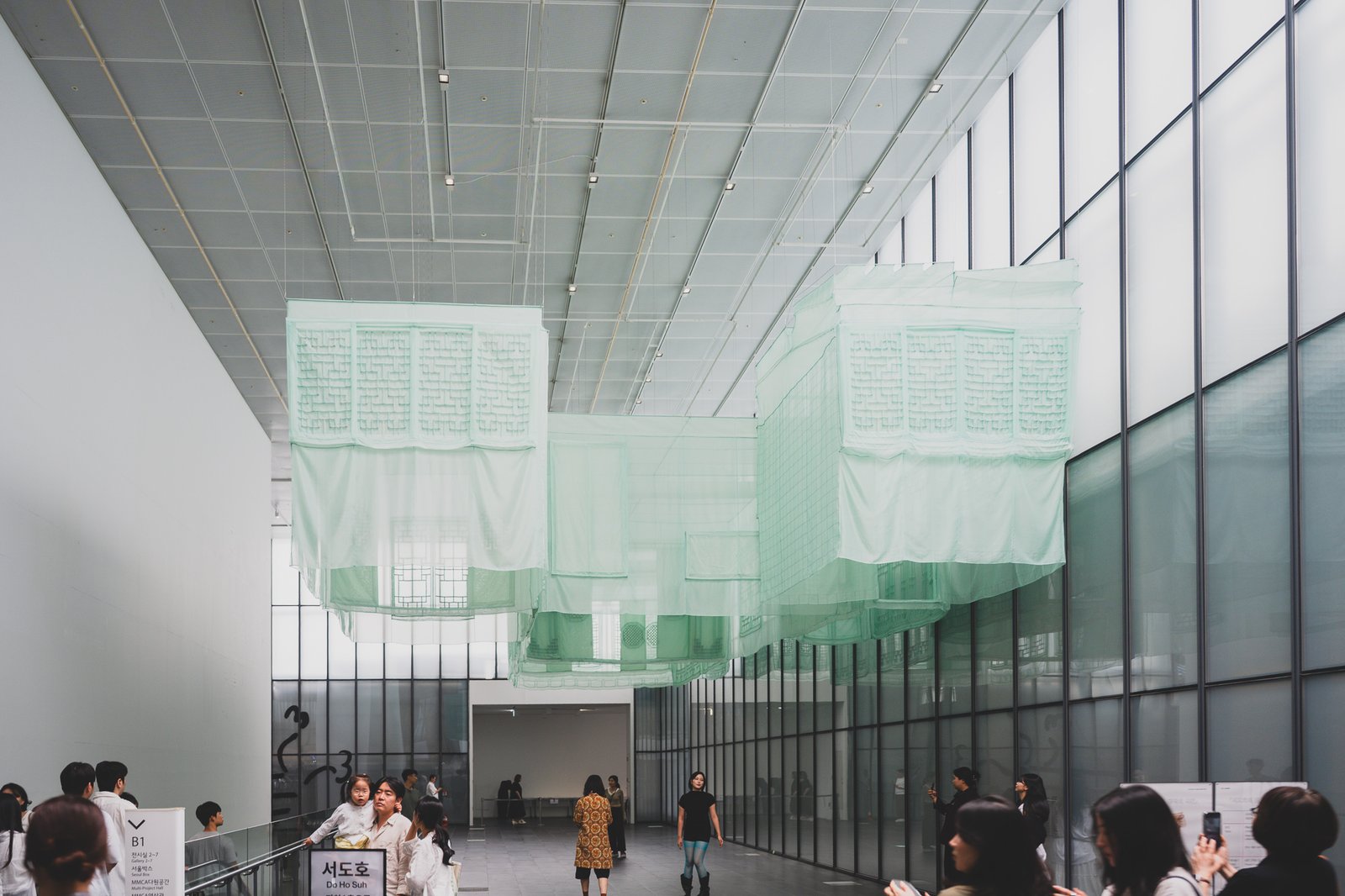
You can see part of the show before you even scan your ticket
One nice touch: before the ticket-check point, there’s already a Do Ho Suh piece hanging in the lobby corridor. A mint-green fabric recreation of a hanok’s eaves and lattice windows floats across the ceiling of the passageway — and anyone walking through the museum can see it, ticket or not. If your schedule doesn’t line up with a booking slot, or you’re just passing through, it’s a small but real taste of the show.
Two hundred drawings you won’t find published anywhere else
Past the entrance piece — a life-size recreation of the gate to Suh’s childhood hanok, titled Fitting/Unfitting: Passage(s) (2017) — the exhibition opens with a wall of roughly 200 drawings.
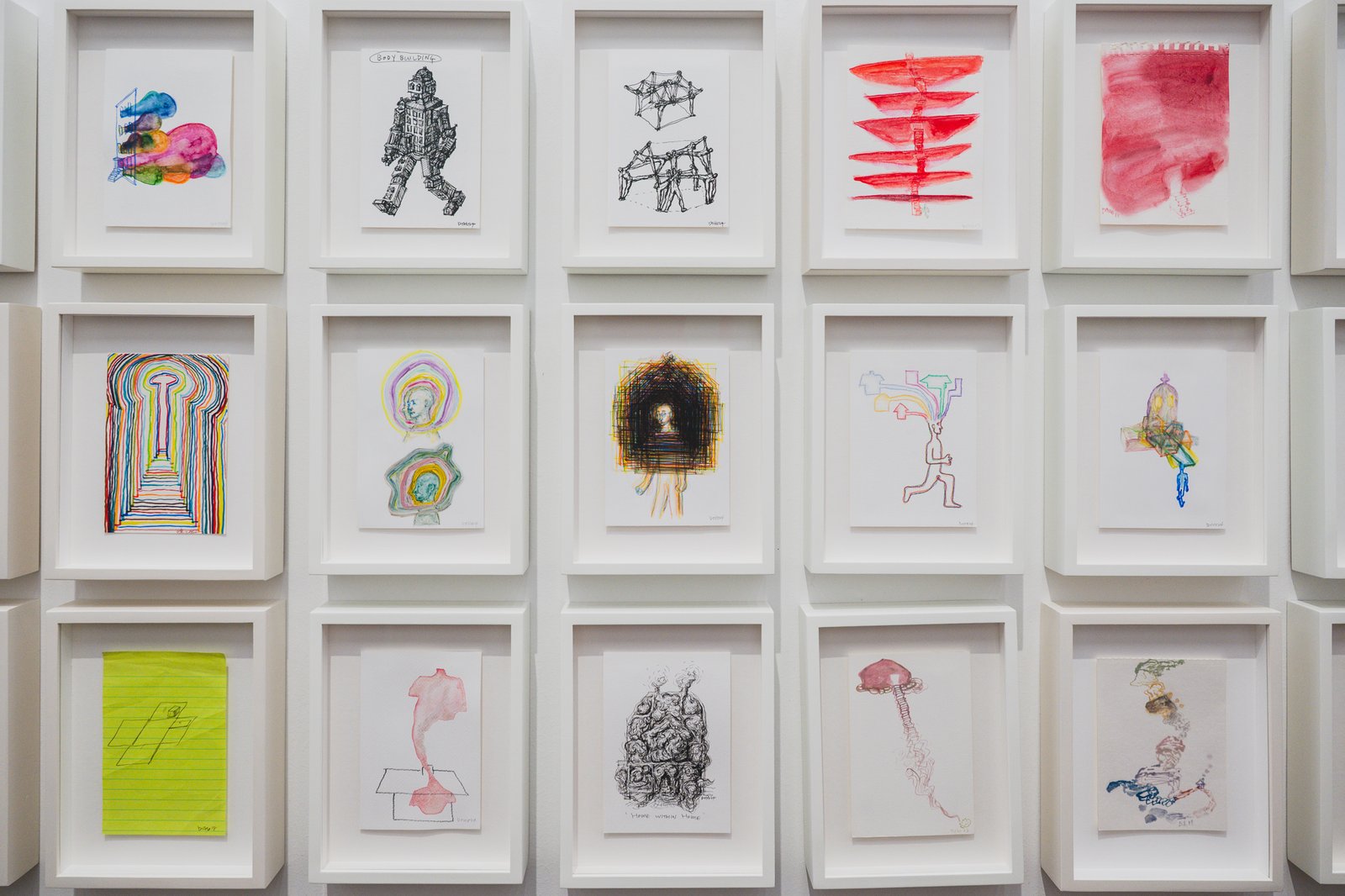
Most artist retrospectives show you the finished work and leave the sketches in storage. Here, the museum’s wall text frames these drawings as complete works in their own right rather than warm-up material — and since most of them are being exhibited in Korea for the first time, this is a genuinely rare chance to see the thinking behind the finished installations.
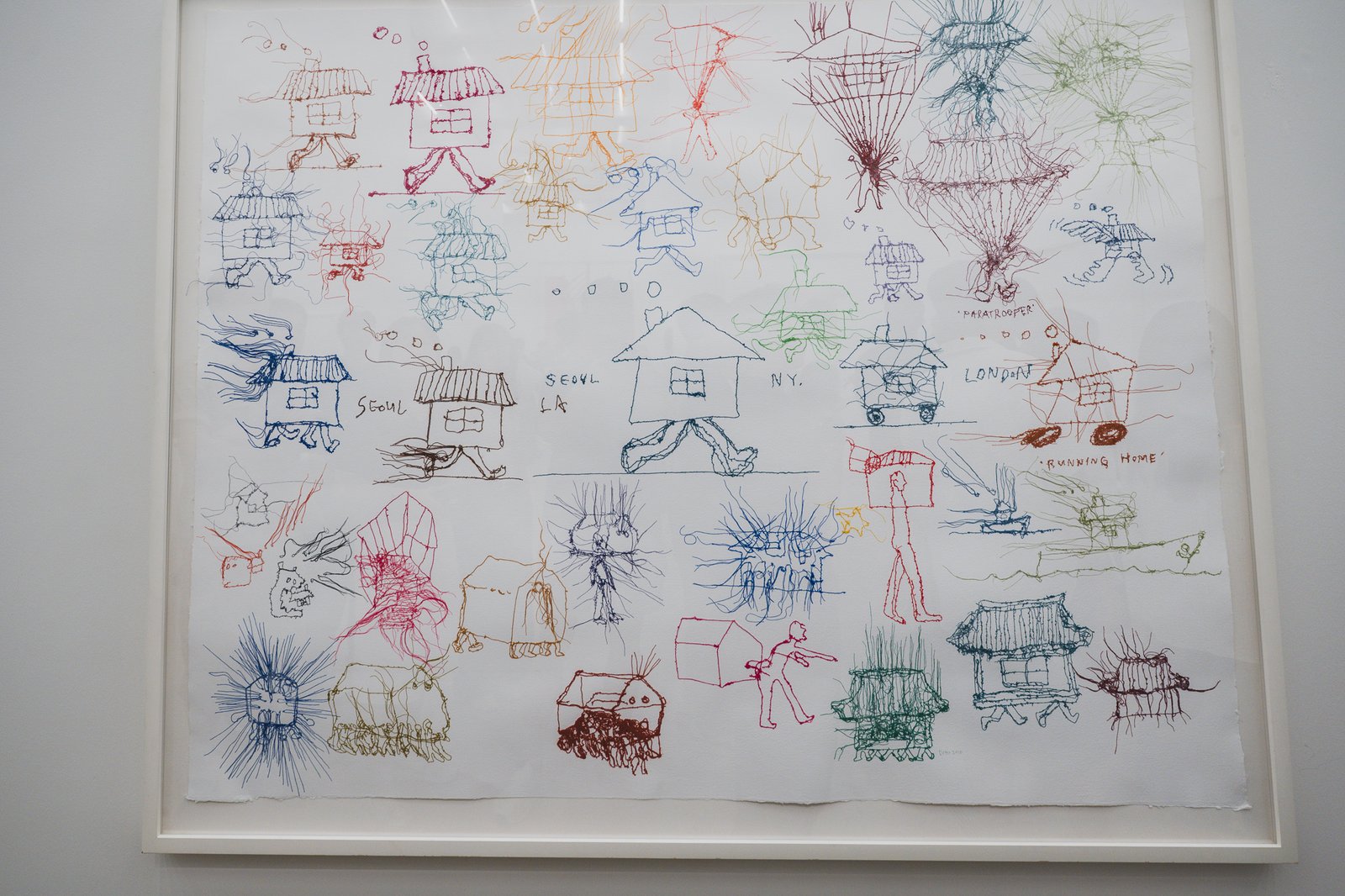
One drawing stopped me longer than any other: a house with a roof and windows, standing on a pair of human legs, walking between the words SEOUL, LA, NY, and LONDON. Given that Suh has actually lived in all four cities, the image reads less like a metaphor and more like a self-portrait — not a person carrying the idea of home with them, but the house itself growing legs and moving.
The thread technique that carries the whole show
From the drawings, the exhibition moves into a technique Suh has developed since 2009 — embedding thread inside handmade paper and gelatin tissue, so the thread sits under the paper’s surface rather than on top of it.
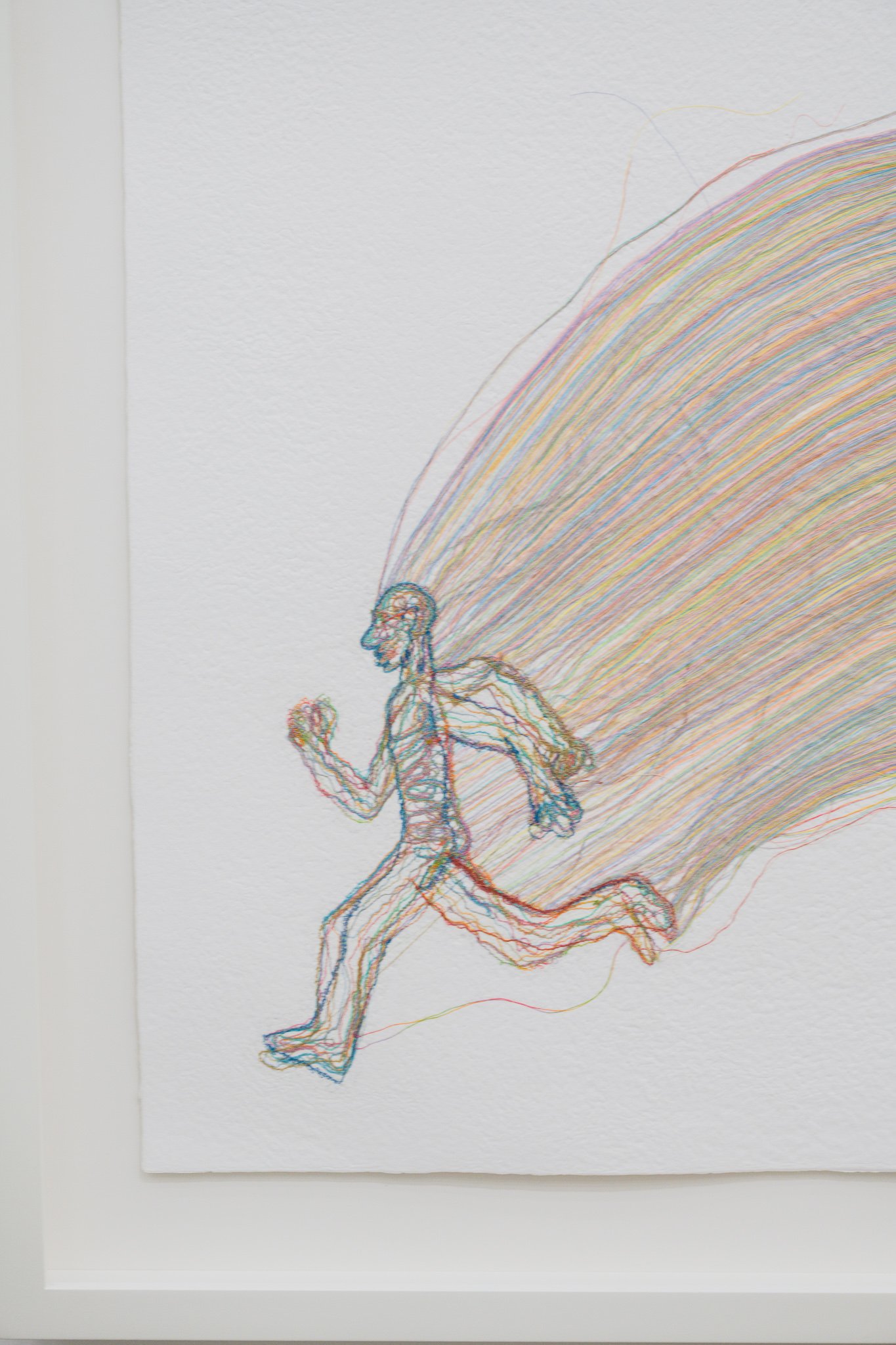
Karma (2010, thread on handmade paper) is the best-known piece using this method — the thread sinks just below the paper’s surface, creating a soft relief effect that’s part textile work, part drawing.
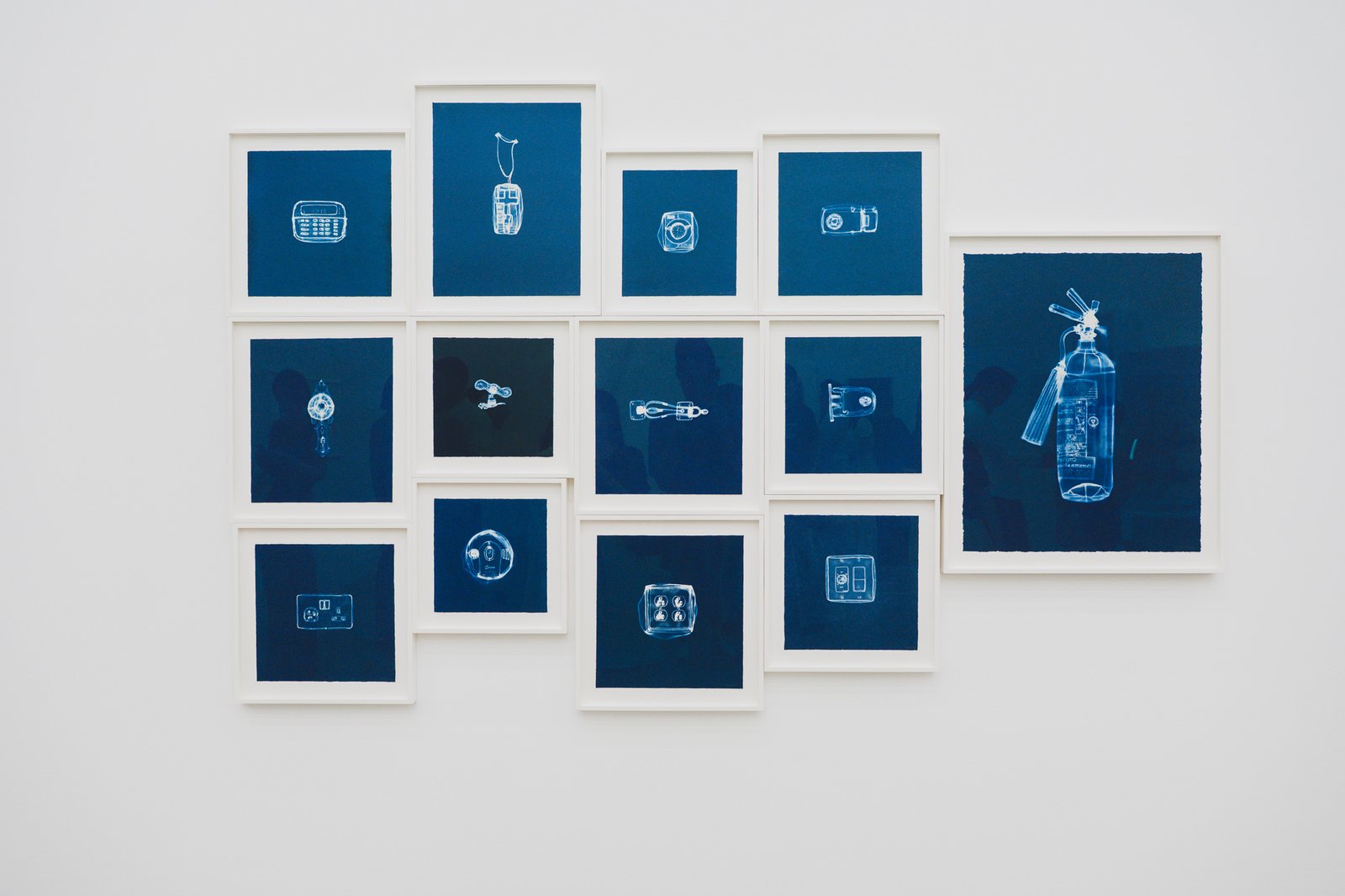
The same technique carries into Self-Portrait/s (2007–2021), a series of blueprint-blue drawings of ordinary household objects: fire extinguishers, outlets, door locks, intercoms. Rendering “self-portraits” through the objects you brush past every day in your own home, rather than through a face, sums up Suh’s whole approach — identity, for him, isn’t a likeness, it’s the sum of the space you’ve lived in.
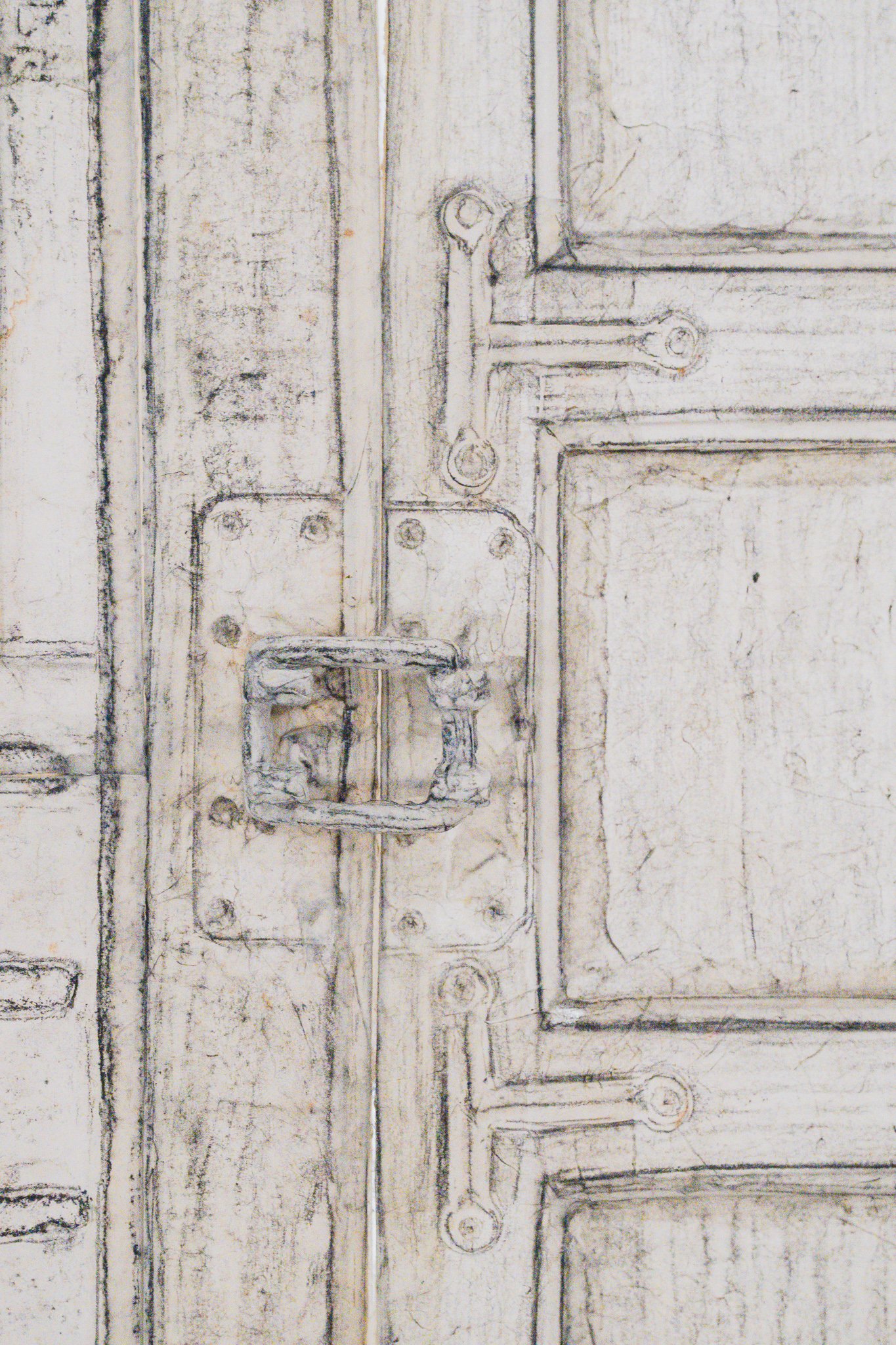
Watching the work get made
One video piece quietly explains how all of this gets made: a short behind-the-scenes film of Suh and an assistant pressing paper against the actual exterior wall of a hanok and rubbing a tool over it — a traditional rubbing (frottage) technique, done at full scale on a real building.
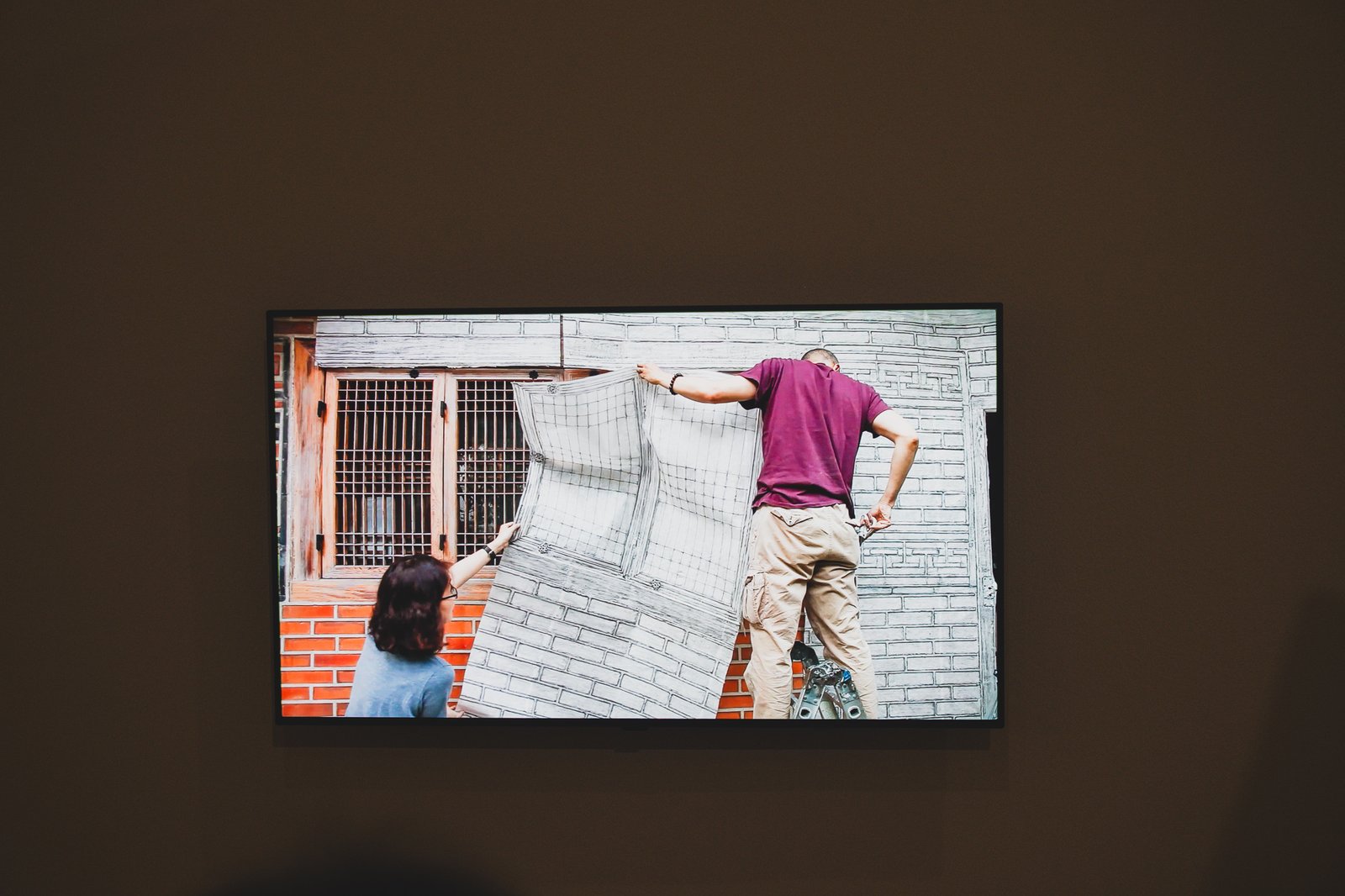
Seeing the physical labor behind these pieces — literally pressing the texture of a brick or a lattice window into paper by hand — changes how you look at the finished thread works. What looks like delicate embroidery from a distance starts, on closer inspection, in a very physical, almost architectural process.
A runway of voices talking about “home”
About halfway through, the exhibition suddenly opens into a long room shaped like a fashion runway — a central walkway with a bench down the middle and a full-height video screen on each side.
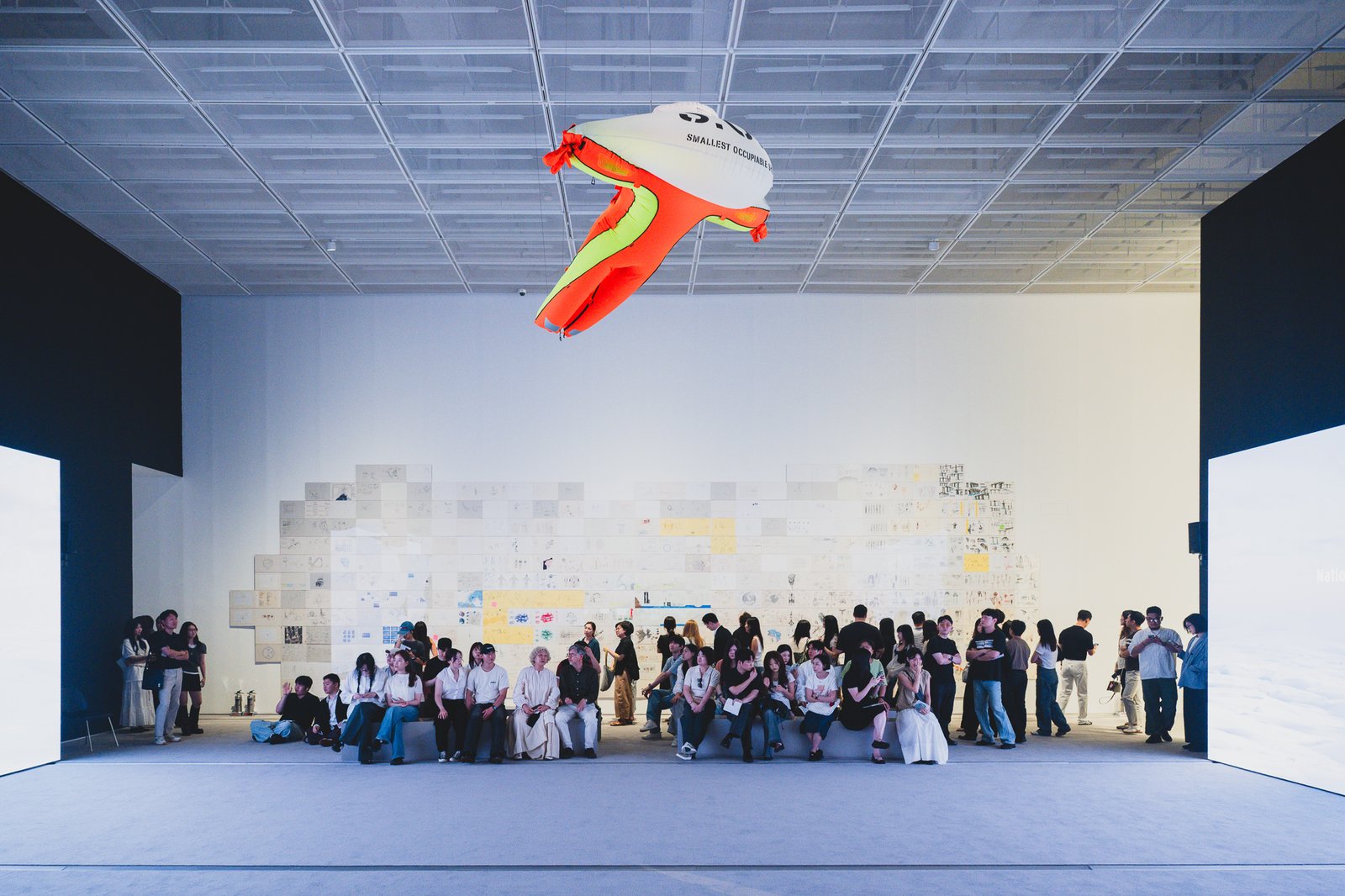
Overhead, balloon-like orange and green inflatable forms hang from the ceiling, one printed with the partial text “SMALLEST OCCUPIABLE S…” — a question about the smallest space a person can actually live in. On the two screens, different people, on camera, answer the same simple question in their own words: what does “home” mean to you? One man’s answer was just a few plain words — small, unpretentious, and somehow more affecting for it. Across the aisle, a different interviewee stretched the definition of “home” out to include an entire hometown, not just a specific address. It’s a simple curatorial device, but it works: everyone in that room is defining “home” completely differently, and Suh’s own decades-long fixation on one specific hanok in Seongbuk-dong suddenly reads as just one very particular answer among many possible ones.
What it’s actually like to walk into the work
Photos of this show don’t do the next part justice — actually walking through it does.
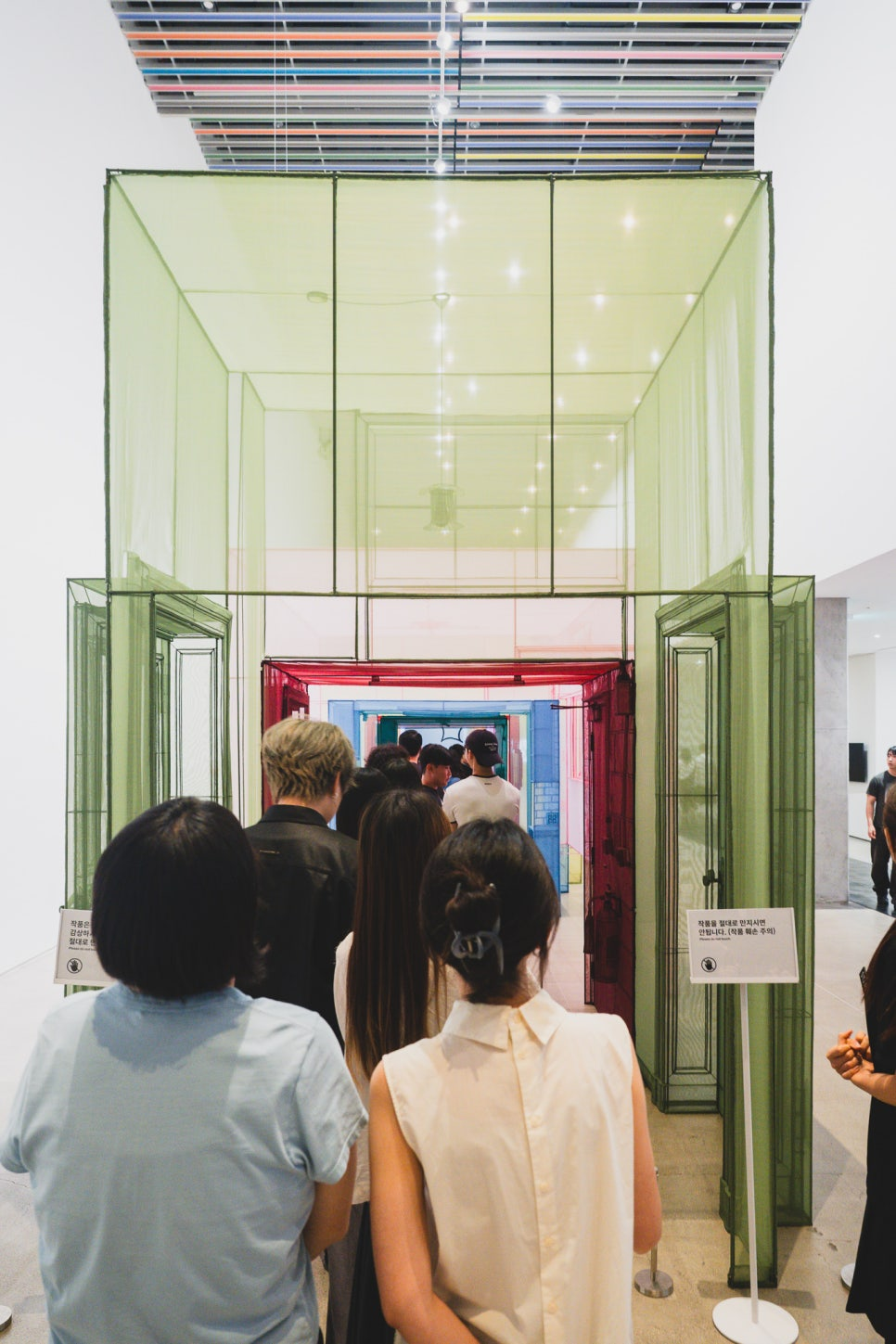
The exhibition’s final stretch scales up dramatically. Suh recreated the doors of houses he actually lived in, at full size, out of thin, translucent fabric instead of solid material — and you’re allowed to walk straight through them.
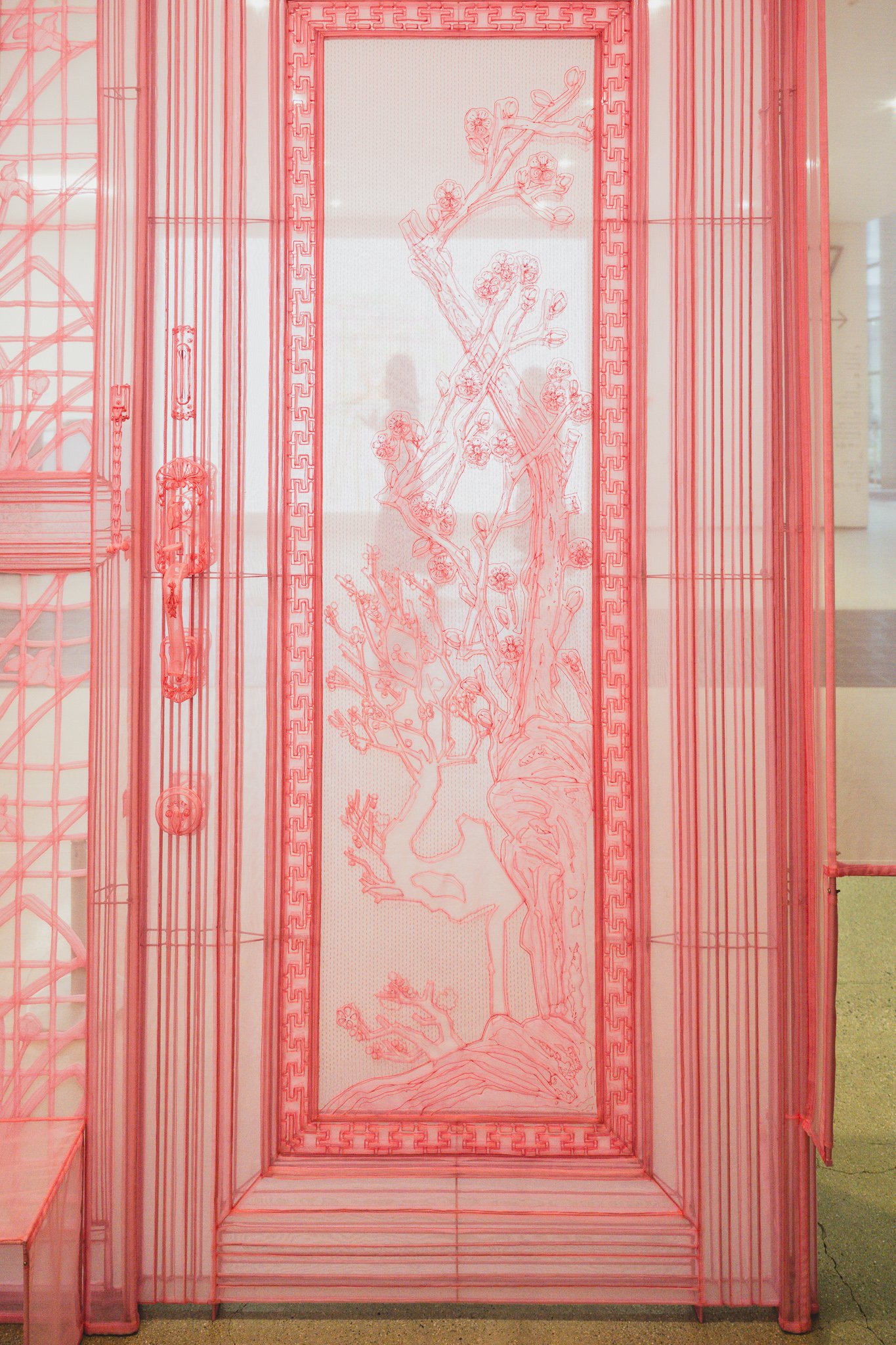
Pushing that bright pink fabric door open is a strange sensation — what looks like a wall from a few steps away turns out to be a single layer of cloth, and it folds away under your hand instead of resisting it. It’s less like opening a door and more like pulling back a curtain into a different room. The door frame itself is built to the exact dimensions of a real hanok door, threshold included, so even the small motion of stepping over the sill registers physically.
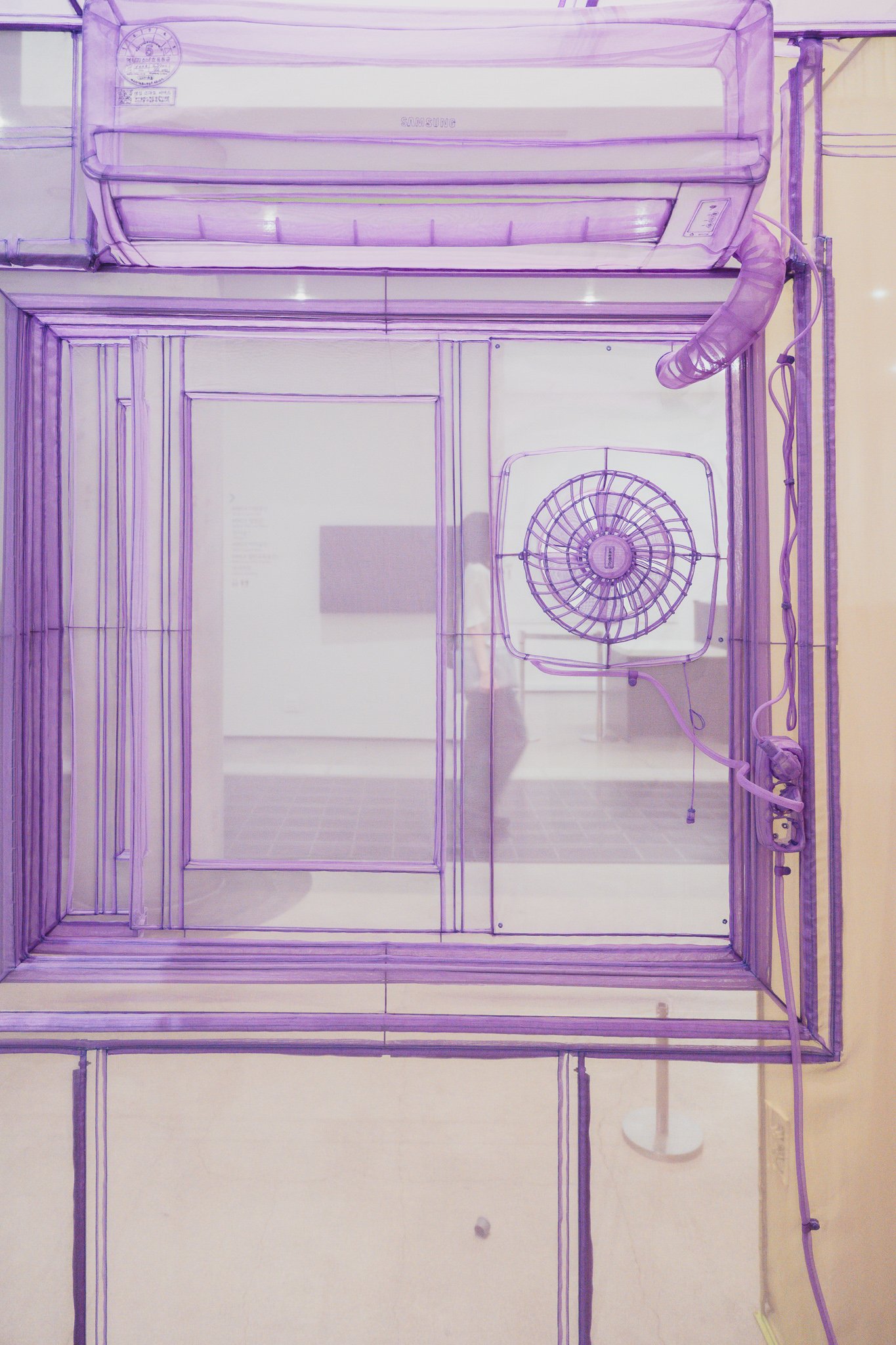
Once you’re inside, the light changes first. Instead of the gallery’s regular lighting, everything is filtered through the translucent fabric walls, scattering into a soft pink and lavender glow — you’re standing inside color rather than just looking at it. Sound changes too: the ambient noise of the gallery drops off almost immediately once you’re past that one thin wall, and for a moment it genuinely feels like you have the room to yourself.
That effect peaks in the final room — a large red thread structure you can also walk inside.
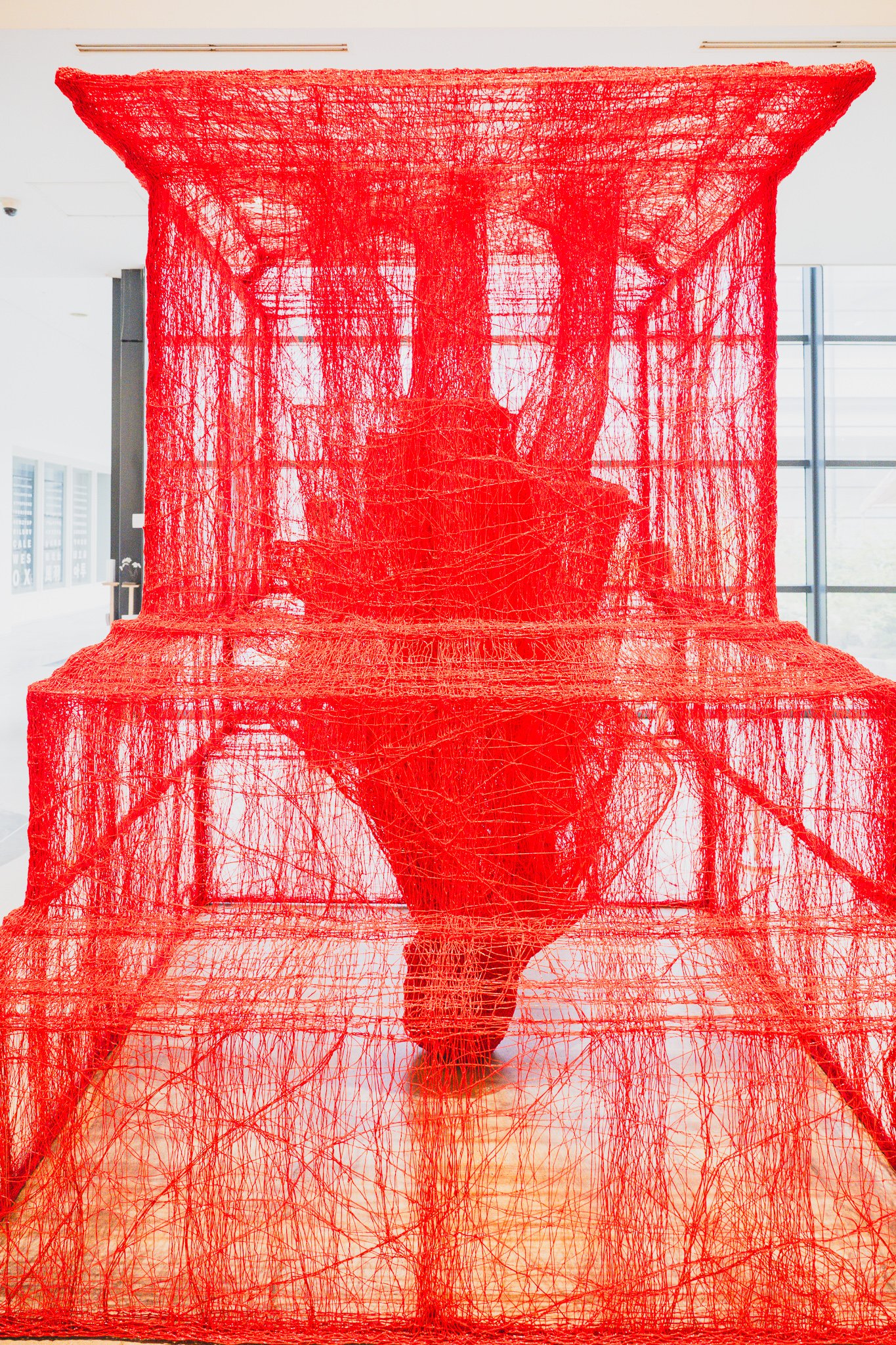
Standing inside it, your entire field of vision turns red, and every small movement makes the shadows cast by the woven thread shift slightly around you. It doesn’t feel like touching a wall — it feels closer to briefly stepping inside the material itself. This is really the point of the whole show: Suh’s work isn’t built to be looked at from a fixed distance, it’s built to be walked through, and the difference between seeing a photo of it and actually crossing that threshold yourself is much bigger than I expected going in.
Fair warning: this room photographs extremely well, so it tends to have the longest wait for an empty shot. Even during an early-morning slot it took some patience — a weekend afternoon booking will likely mean a longer wait.
FAQ
Q: Do I need to book a specific time slot, or can I just show up?
A: You can try walking in, but the line for walk-ins was long when I visited. Booking a one-hour slot in advance (via MMCA’s site or Naver) is strongly recommended, especially on weekends.
Q: Is any part of the exhibition free to see without a ticket?
A: Yes — a fabric ceiling installation in the lobby corridor, before the ticket-check point, is visible to anyone passing through the museum.
Q: How long should I plan for the visit?
A: Budget at least 1.5 hours. The show is large, involves a fair amount of walking between rooms, and the walk-through fabric installations are worth lingering in.
Q: Is the museum accessible without a Korean phone number or Naver account?
A: You can book directly through MMCA’s own ticketing site, which doesn’t require a Korean phone number the way Naver Reservation does.
Q: Does the exhibition have English wall text?
A: MMCA is a national museum and typically provides English labels alongside Korean ones for major exhibitions, though the depth of translation can vary by section.
Bottom line
This is worth going out of your way for if you’re interested in Korean contemporary art, or if you’ve only known Do Ho Suh through photos of his fabric houses and want to actually feel the difference in person. It’s also a good pick if you want a break from Seoul’s more Instagram-driven pop-up scene — this show has real substance behind the photogenic rooms. Wear comfortable shoes; there’s more walking than a typical single-floor gallery visit, and the fabric-room sections are worth taking slowly rather than rushing through.
This post reflects an early-bird visit to the exhibition in August 2026; hours and ticket pricing may be adjusted by MMCA over the run of the show — check the official site before you go.
Pingback: 16 Seoul Exhibitions Worth Seeing During Frieze Seoul Week 2026 - SeoulScout