TL;DR: “The Third Poem: Es Devlin, Come Home Again” at Futura Seoul in Bukchon is a timed-entry immersive exhibition — not a walk-around-at-your-own-pace gallery. Groups enter together at set intervals, starting with a library wall that opens to reveal a mirror maze, then moving through several more installations to a rooftop overlooking Bukchon’s hanok village. General admission is 22,000 KRW, and it runs through January 17, 2027. No cameras allowed inside — phones only.
I’d written up the early-bird ticket info for this exhibition when it was announced, telling myself I’d go see it in person and report back properly. I made it in on day three, and within minutes it was clear that the ticket-info post barely scratched the surface of what this show actually does.
Where it is and the basics
Location: Futura Seoul, 61 Bukchon-ro, Jongno-gu, Seoul (Bukchon)
Dates: August 20, 2026 – January 17, 2027 (closed Mondays)
Hours: Tue/Wed/Thu/Fri/Sun 10:00 AM–6:00 PM, Sat 10:00 AM–7:00 PM
Admission: General 22,000 KRW (age 19+) / University students 15,000 KRW (with valid student ID, grad students excluded) / Youth & children 12,000 KRW (ages 2–18) / Groups (adult rate) 17,600 KRW / Free under age 2
Parking: Not available on-site — use a nearby public parking lot
Note: No cameras allowed inside the exhibition (phones are fine)
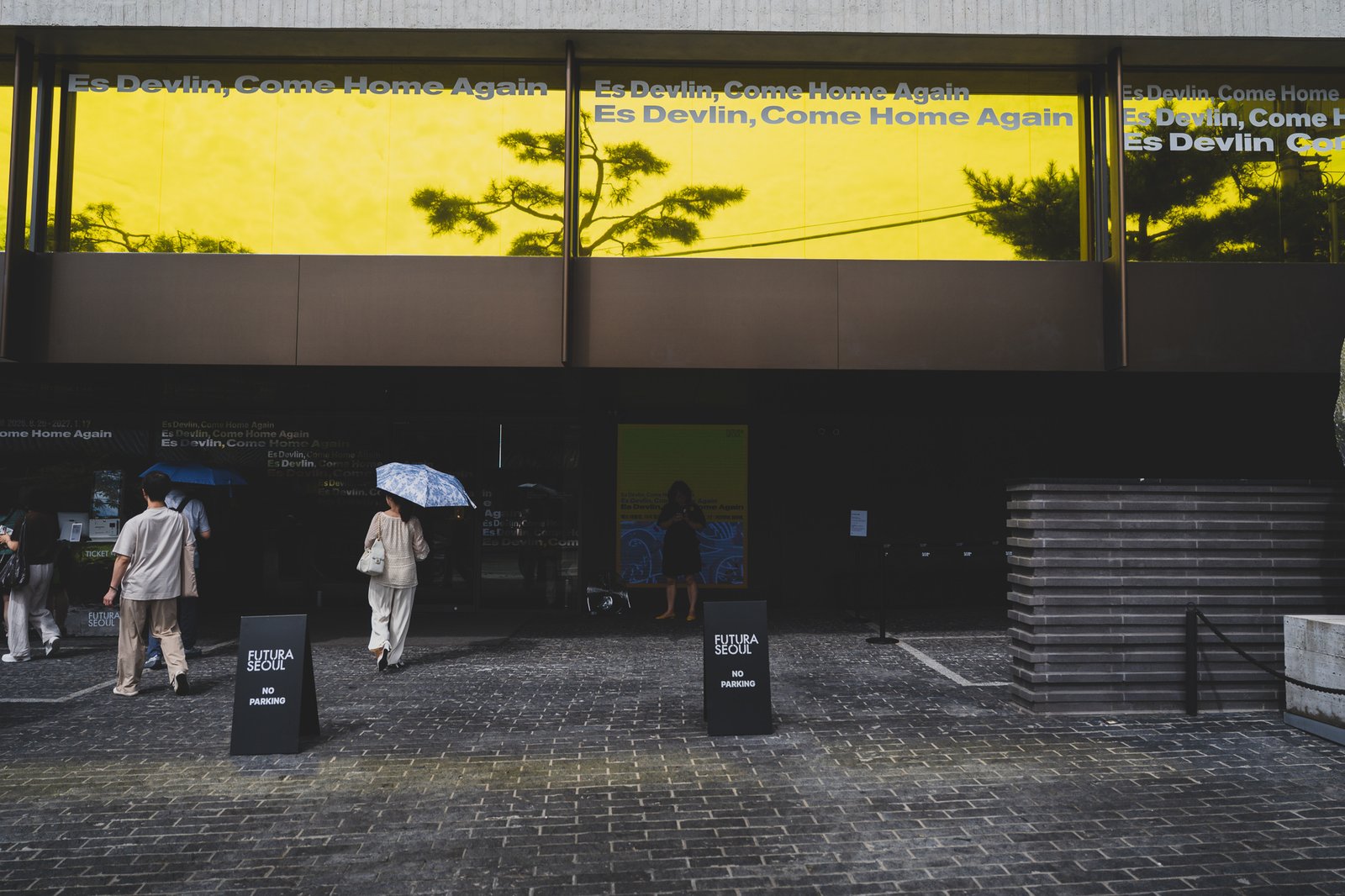
The first thing that sets this exhibition apart from a typical pop-up or gallery show is how you enter. You’re not let in individually as your ticket is scanned — staff hold a group in the lobby and send everyone in together at a set time. My first thought was “why the wait?” The reason becomes obvious the moment you’re inside: this show is built so the group experiences the same beat at the same time, which is exactly what makes the first big reveal land.
1. Infinite Library — a wall that isn’t just a wall
After your ticket is checked, staff gather the group and lead everyone in together — no wandering in solo. The first installation, INFINITE LIBRARY, is a room built entirely out of bookshelves, with a bench where the group sits together for a roughly 5-minute film.
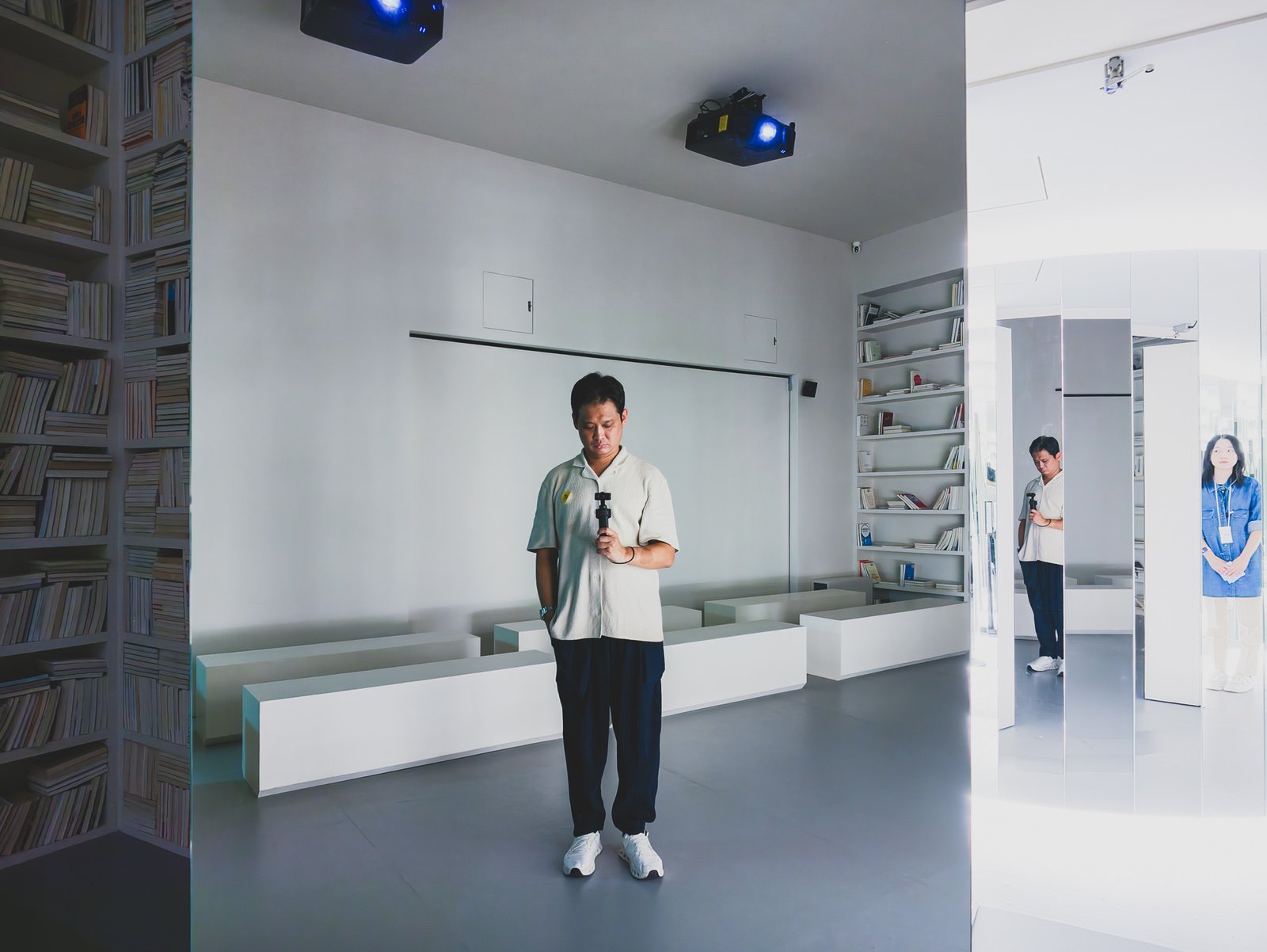
Here’s the part that surprised me most: those shelves are real books — an estimated 10,000 actual volumes, not printed spines standing in as set dressing. The lighting and the alignment of the shelves are so precise that, before I started taking photos, I genuinely couldn’t tell if I was standing in a real library or a set.
The 5-minute film that plays inside isn’t just an intro — it’s effectively the key to understanding the whole show. It explains why the artist chose “coming home” as the exhibition’s theme, and why mirrors, books, and nature are woven together throughout. Skip the film and head straight to the next room, and everything that follows would probably just look like pretty installation art without the thread connecting it.
The moment the film ends is the exhibition’s first real climax: the entire wall of books that’s been facing you splits open, revealing a hidden mirrored room behind it.
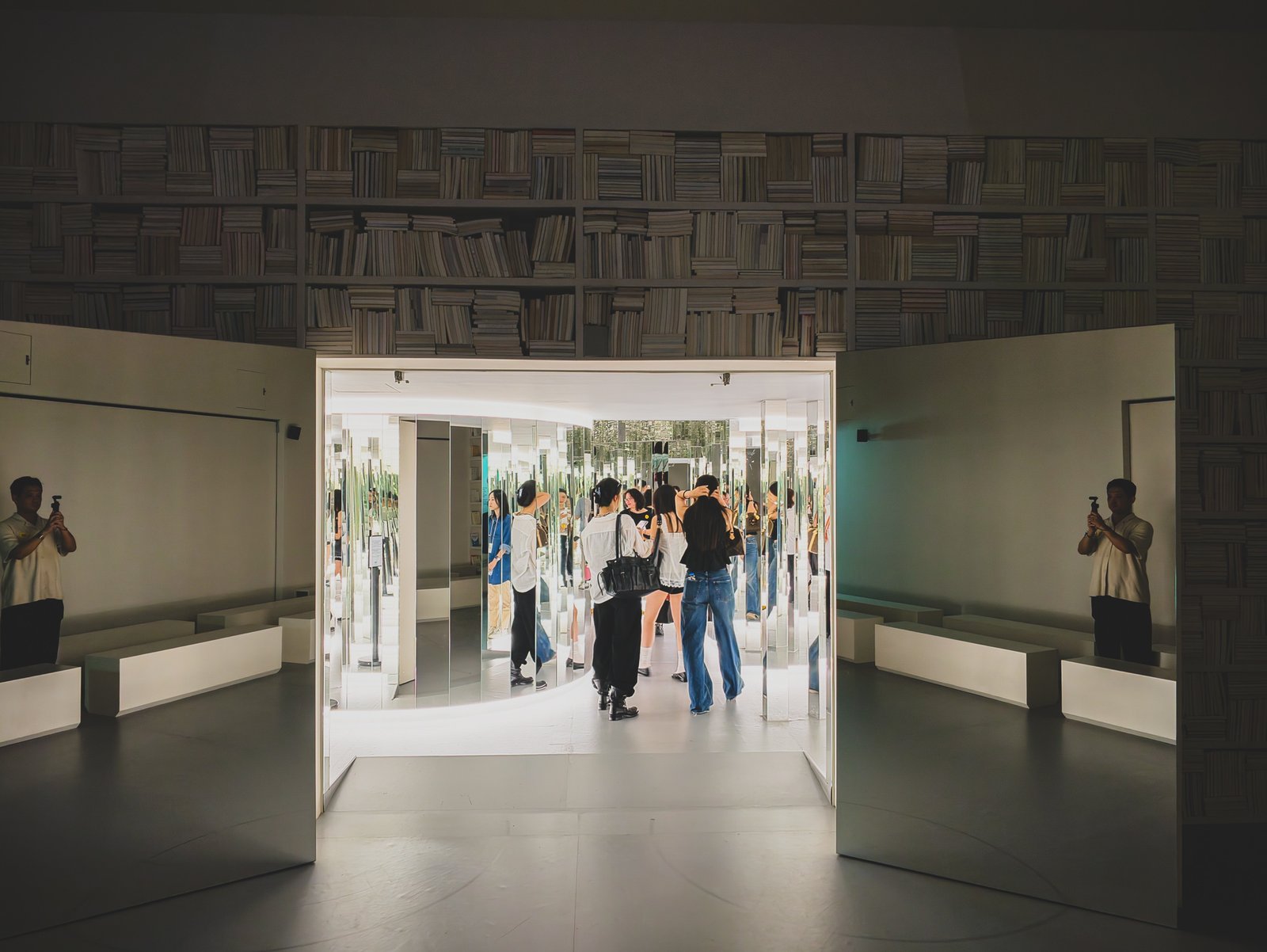
Until that exact second, there’s no hint that the bookshelf wall doubles as a door. A library suddenly becomes a portal to somewhere else entirely — and it’s the answer to why everyone’s brought in as a group to watch the film together. If you’d walked in on your own, off-sync with everyone else, the reveal would have landed at half the impact.
2. Mirror Maze — not everything that looks like a mirror is one
Step through the bookshelves and you’re in a completely different space. Walking between endless mirrored columns, your own reflection and every other visitor’s multiply in every direction, to the point where it becomes momentarily hard to tell which way is a walkway and which is a wall.
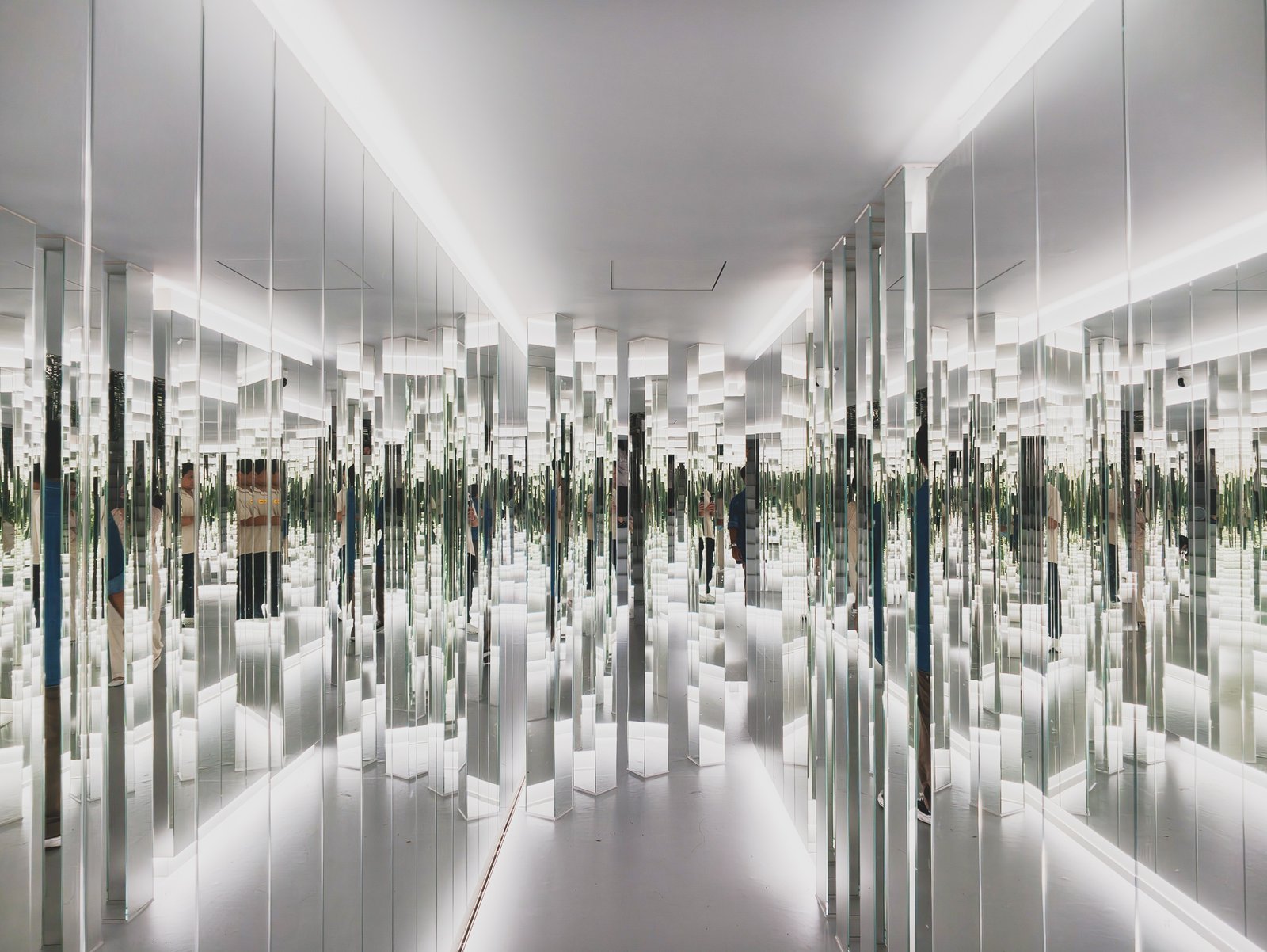
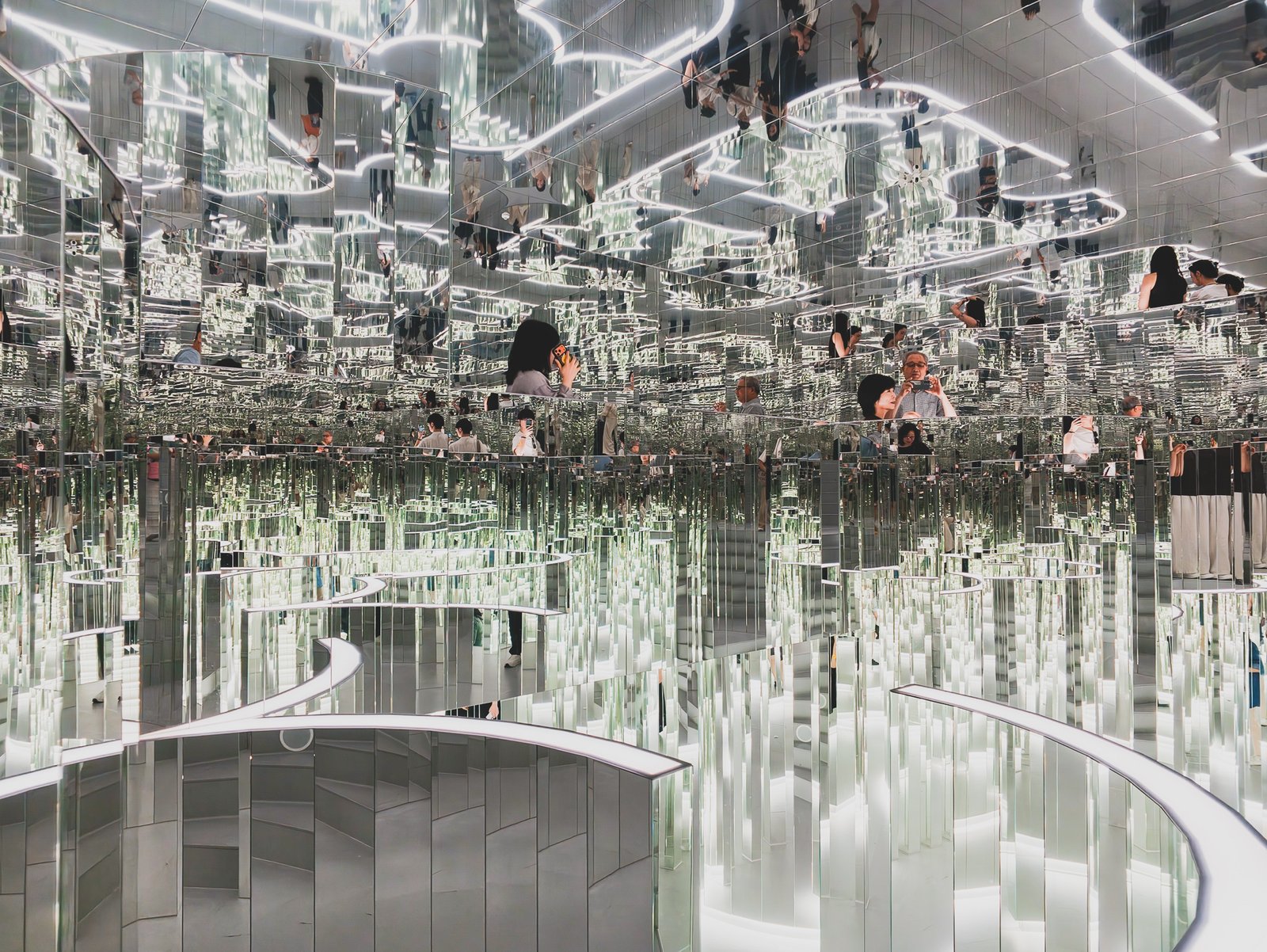
My first assumption was that the whole room was mirrored. Walking further in, there’s a second twist: some sections use columns with deliberately lowered reflectivity, so instead of a crisp reflection, you get a blurred, half-formed image. That subtle difference in reflectivity is what actually creates the tension in the space — there were moments I genuinely couldn’t tell if I was standing in the real path or looking at a reflection of it. A room that was “just a lot of mirrors” wouldn’t have been nearly as memorable; this one small design choice in reflectivity changes the whole feeling of the space.
There’s a dreamlike soundtrack running through it too, so the disorientation hits you visually and audibly at once. This is, for my money, both the most photogenic room in the show and the one that photos genuinely undersell — you have to walk through it to get what it’s doing.
Exiting the maze, a staircase lit in red leads up — and there’s an unexpected bonus here. The walls are covered with the actual architectural drawings, cross-sections, and sketches used to design the maze you just walked through.
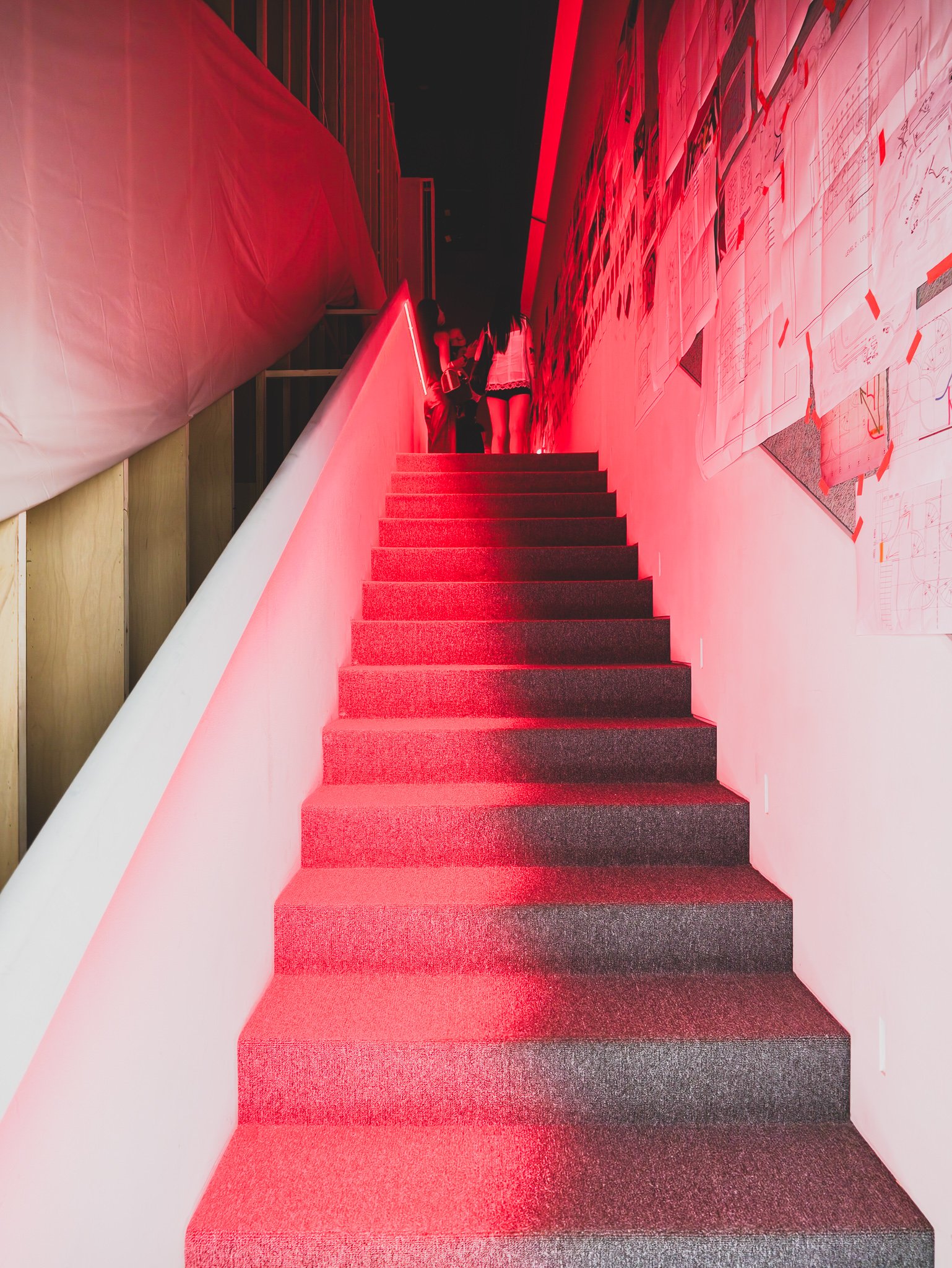
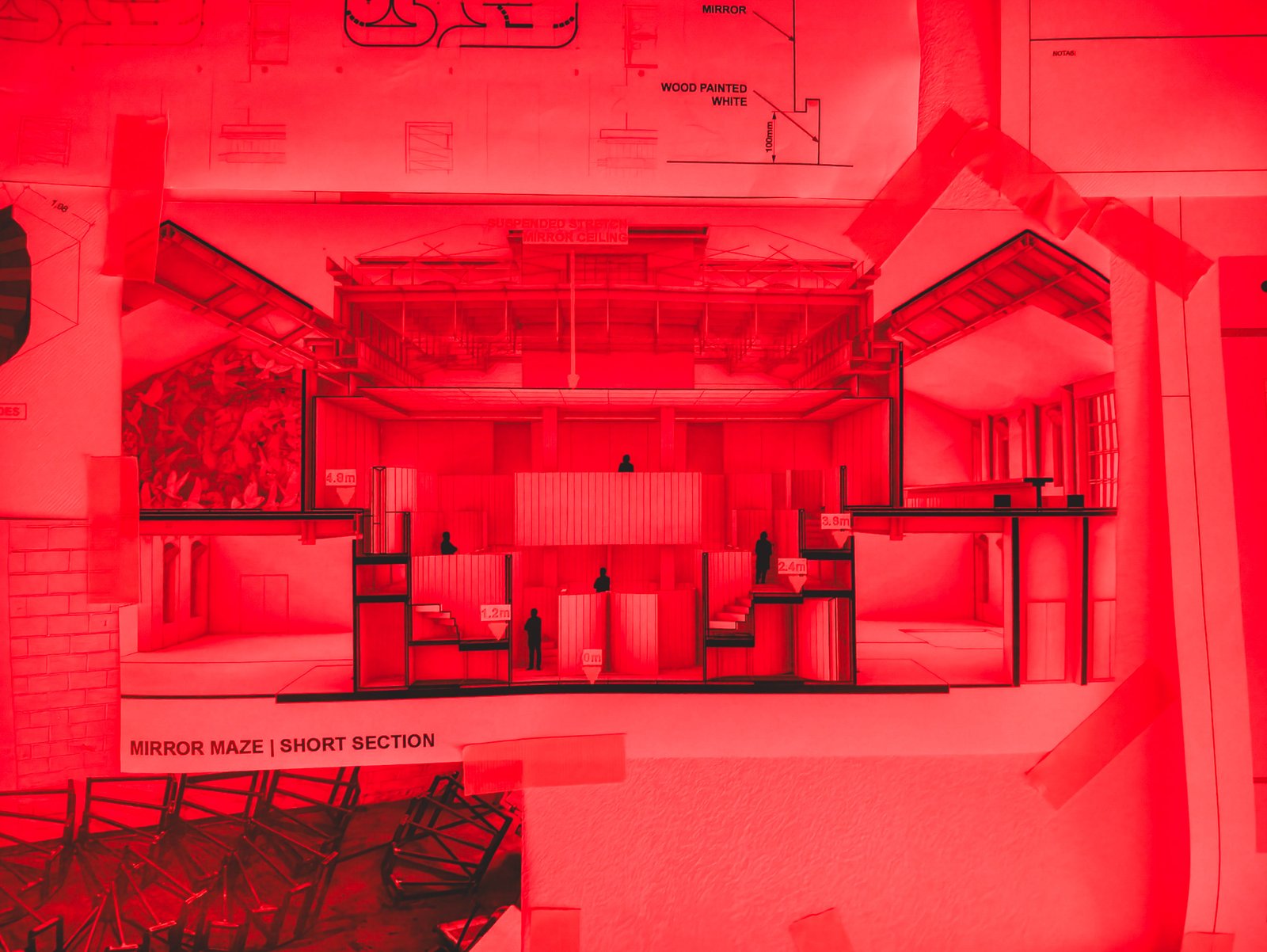
What felt, moments earlier, like a subtle physical sensation of shifting reflectivity turns out to have been precisely engineered at the blueprint stage. Showing the design process alongside the finished work — rather than just the finished work alone — felt distinctly like something a former stage designer would do (Devlin’s background is in stage design). This section isn’t part of the official artwork list, more of a bonus, but I found it almost as compelling as the maze itself.
3. Come Home Again — a new work made for Seoul
At the top of the red staircase, a sign reading “exhibition continues” points toward the next set of works.
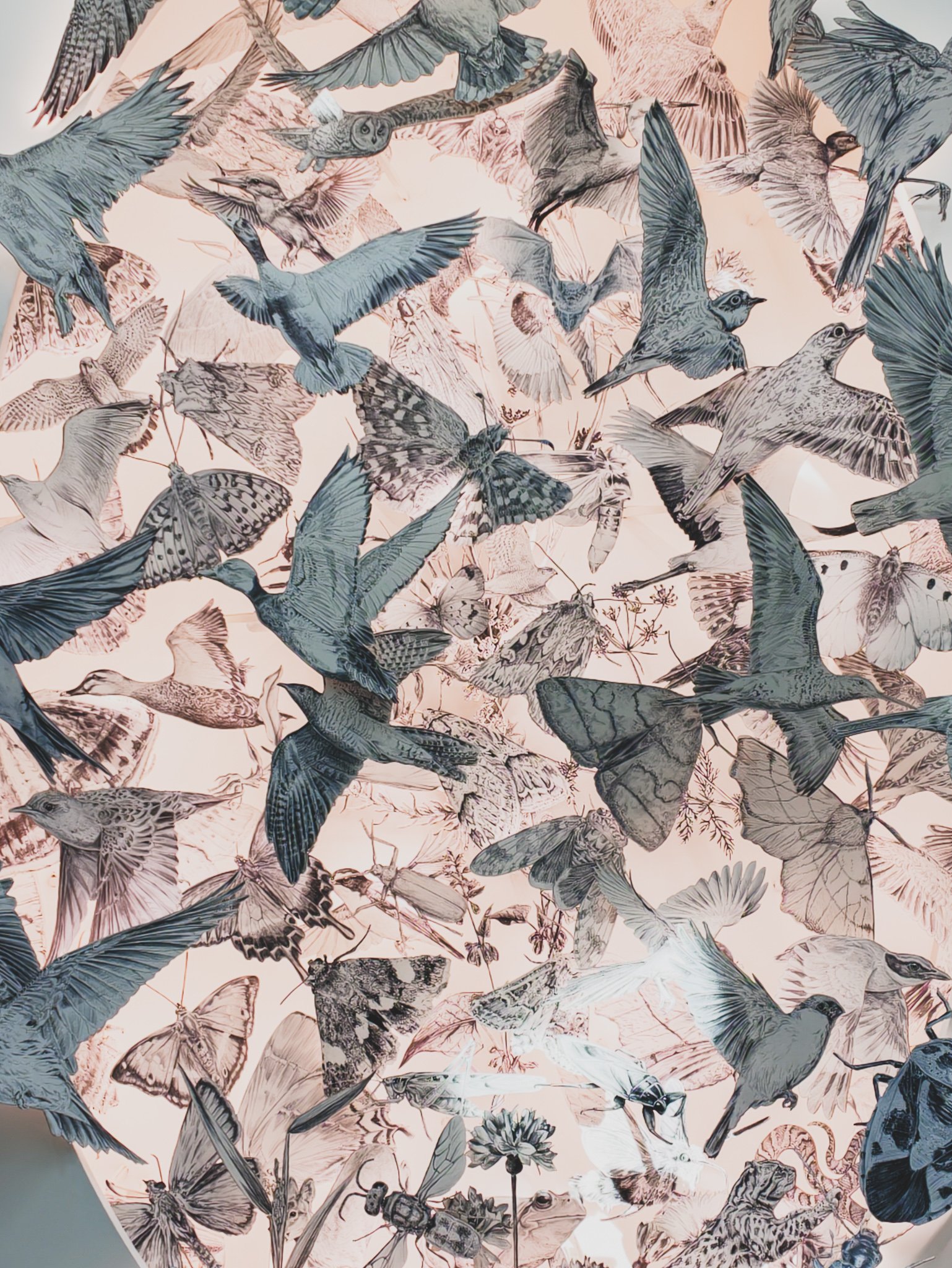
A large-scale wall piece fills the space with birds, butterflies, and insects drawn in painstaking detail, arranged inside a fingerprint-shaped silhouette. The wall text traces the word “dome” back to its original meaning of “home,” framing the piece around the idea that our homes and cities are one interconnected web of species and cultures. A quote from climate activist Joanna Macy is included too — “we return to the felt sense of belonging to each other” — a line that stuck with me. Going in, I only knew this was billed as “a new work for Seoul”; seeing it in person, it’s not just decorative illustration but a piece specifically about endangered species, rendered through meticulous drawing. Futura Seoul commissioned this specifically for its Seoul run, which says something about the space not simply importing a touring show wholesale.
4. Screenshare — a piece you can actually take a piece of
The next room is a total shift in tone. An entire wall covered in hundreds of sketchbook pages becomes a screen, with footage of a dancer projected across it.
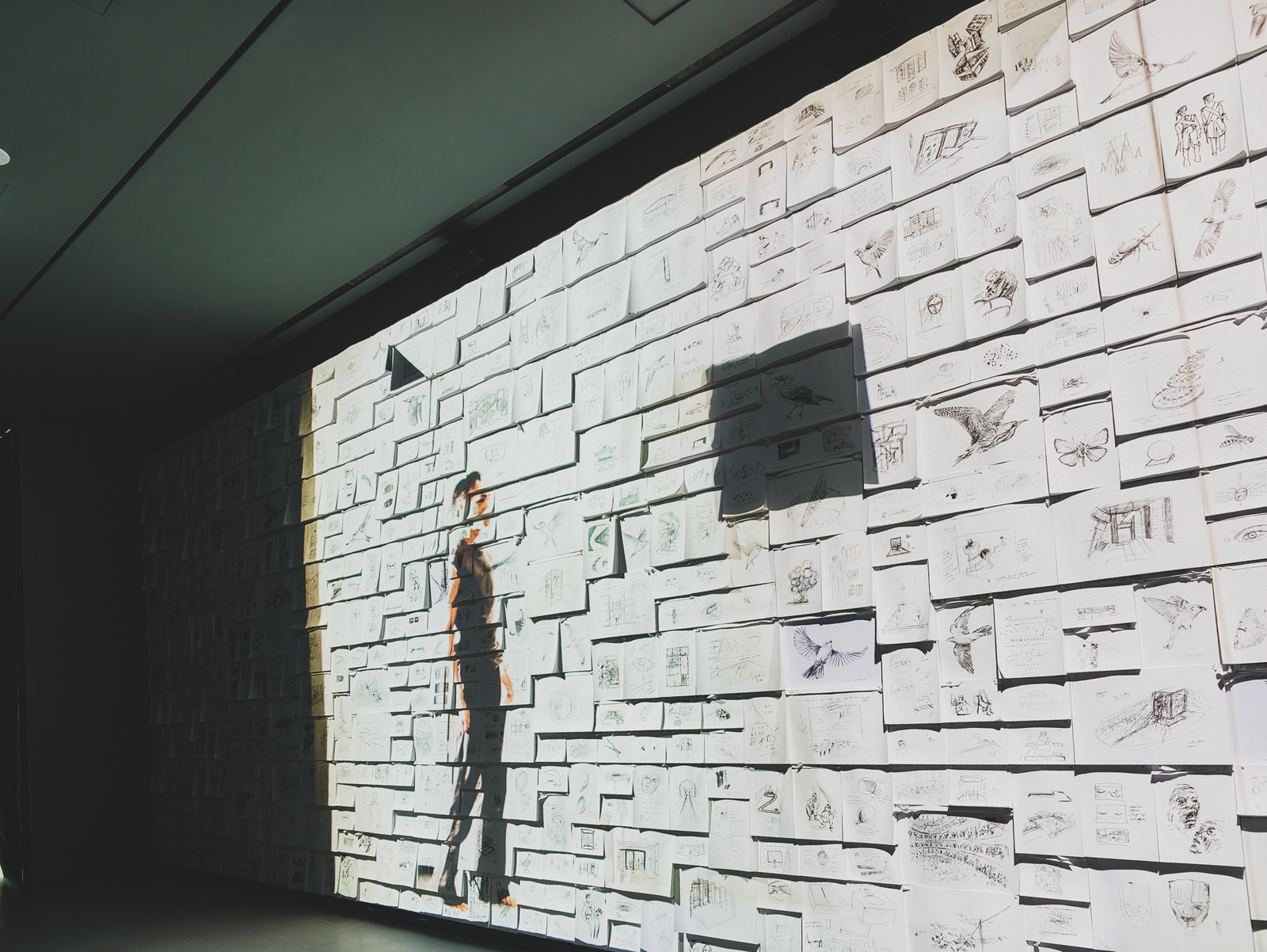
The wall text explains these are pages from 35 years of the artist’s own sketchbooks — drawings of London’s wildlife, drawings of her own children, working notes shared with collaborators over the years. There’s footage from 2008 of the artist dancing alongside a performer, so the person on screen from 18 years ago appears to dance with who she is now. Once the video ends, visitors are invited to actually take a page from the wall — one sketch, physically pulled off the “screen” and kept.
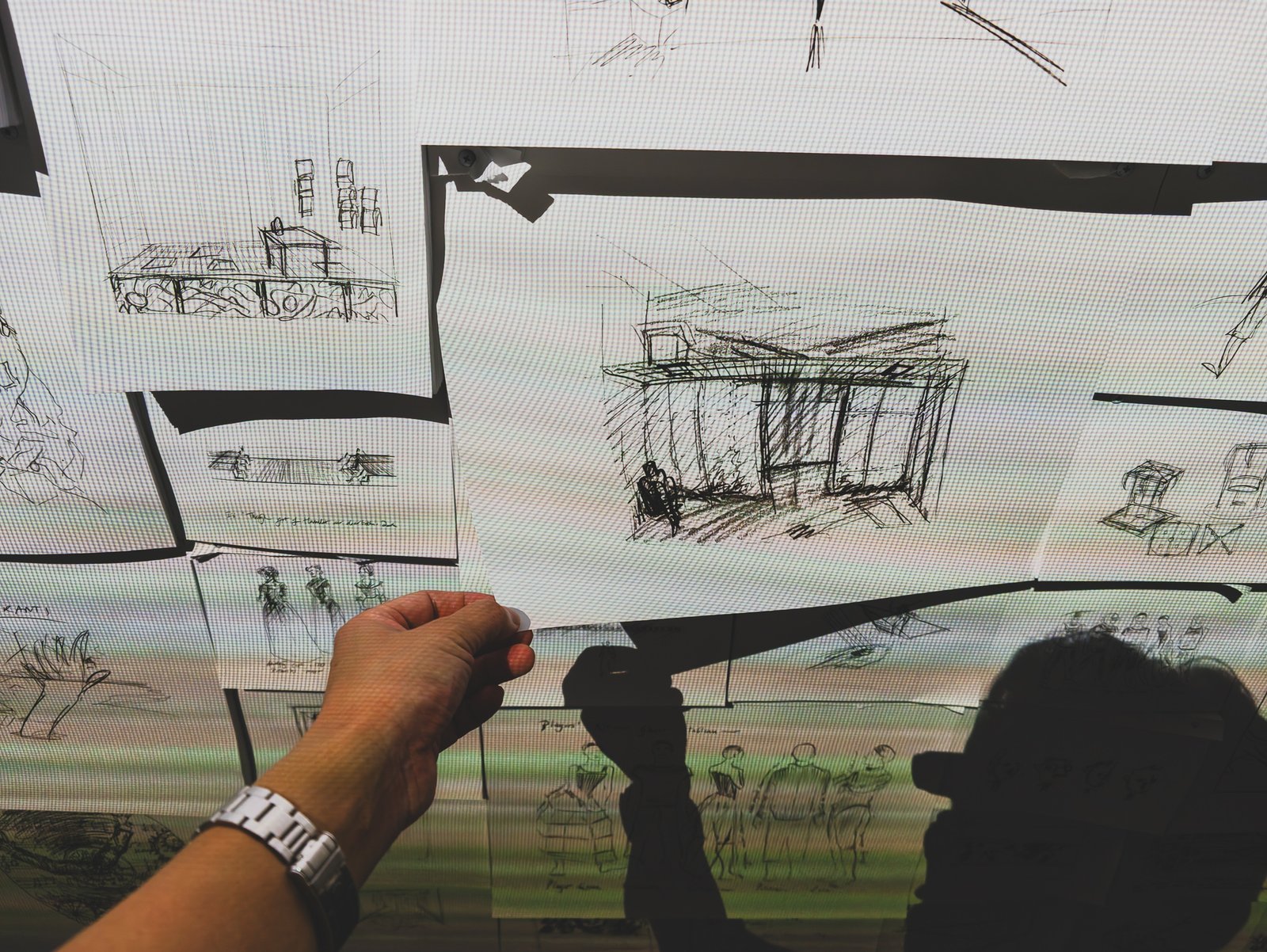
The idea, as the wall text puts it, is that the work doesn’t end inside the gallery — a hand-drawn image travels out into someone’s life like a seed. That framing is what makes the “you can take this” mechanic make sense.
5. Line of Light — where light and water meet
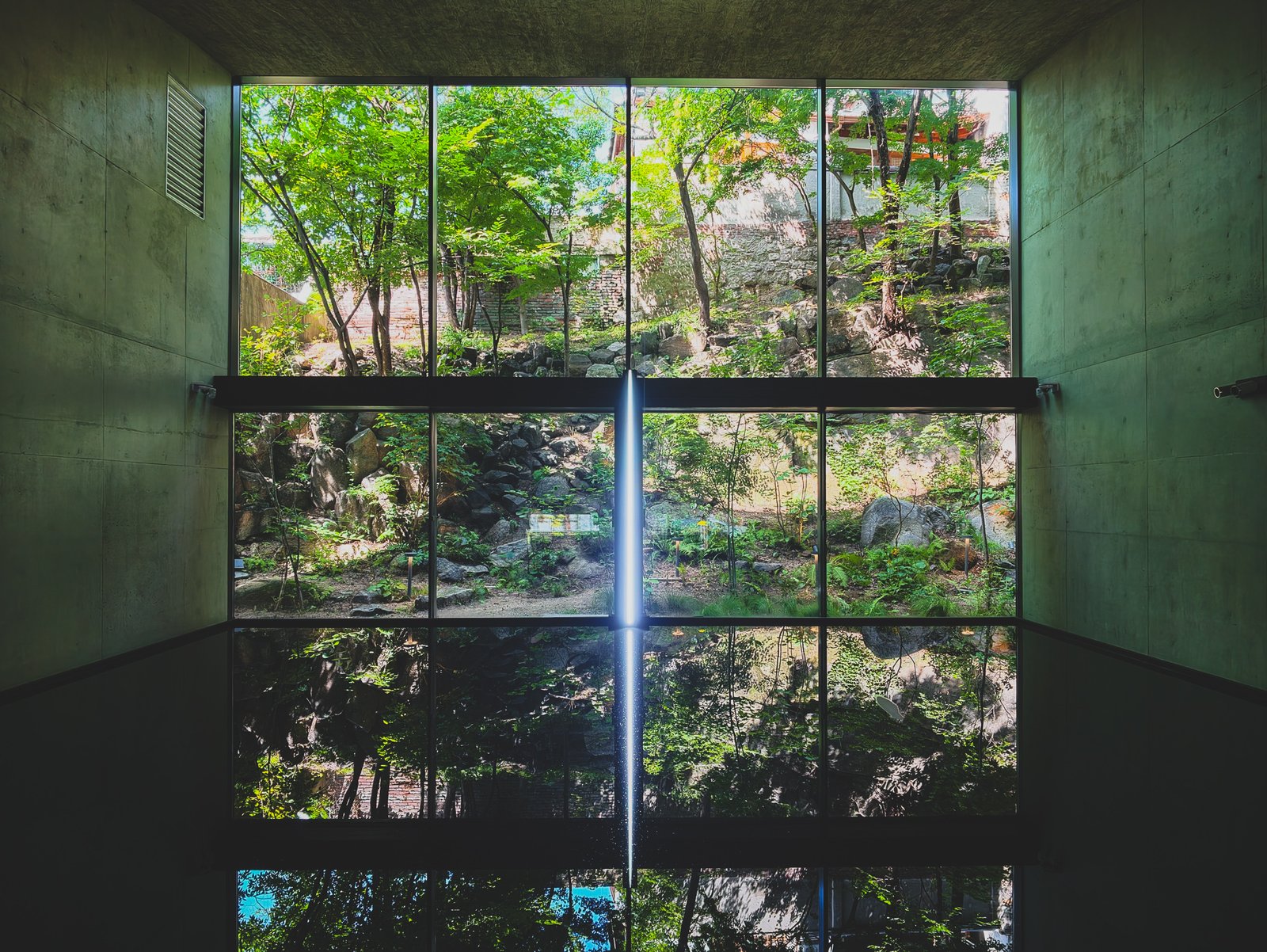
The next room looks out through floor-to-ceiling glass onto Bukchon’s own garden, rocks, and trees. A single strobe of light cuts vertically down the center of that glass, reflecting off a shallow pool of water on the floor.
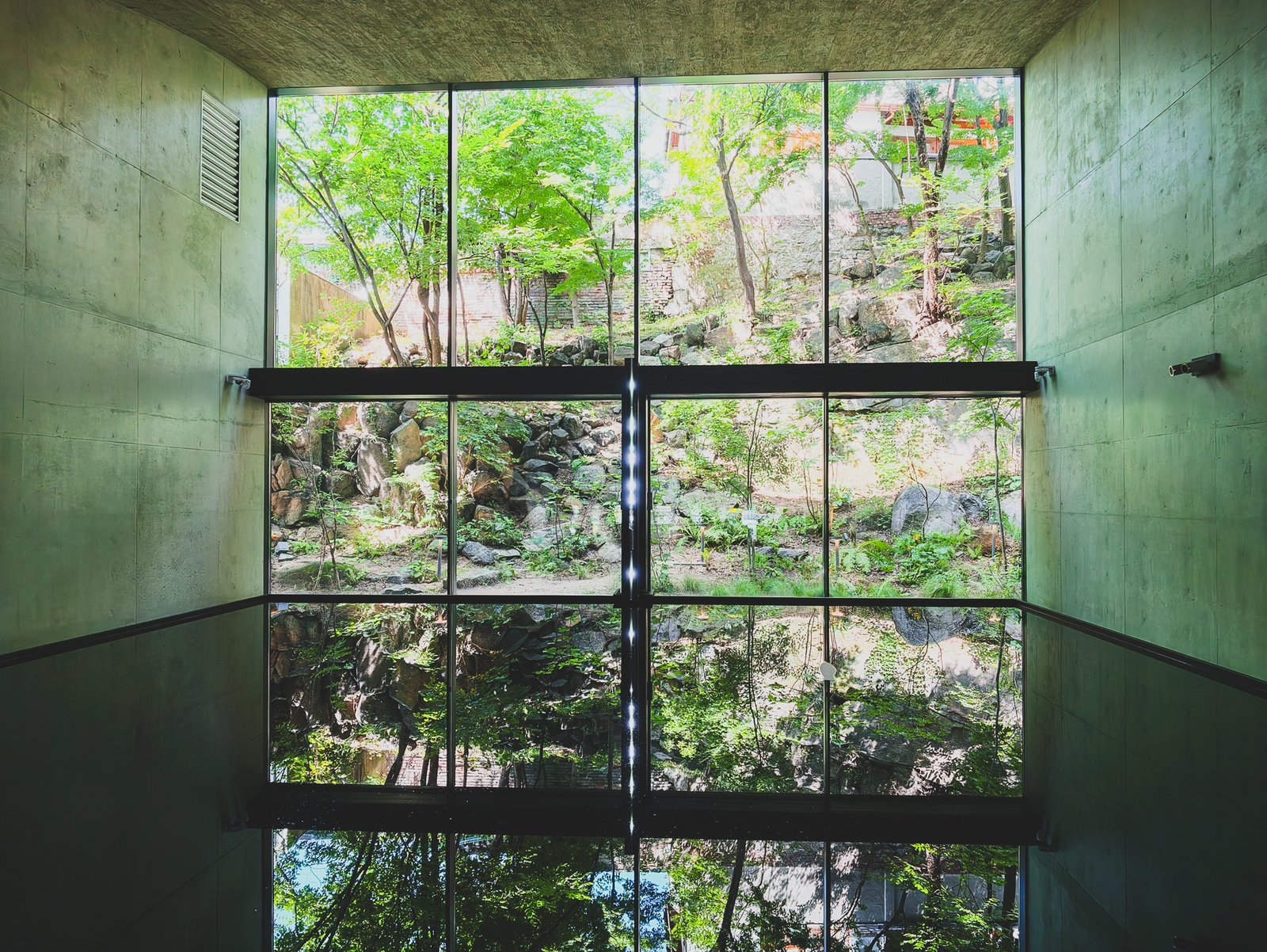
The artist’s statement on the wall is worth reading in full — it opens with “I woke seeing one line of light. It was the only clue I had to orient myself in the world,” describing not knowing what room or country she was in, only that one line — and knowing that the longer she looked at its geometry, the more she’d find in it. If the mirror maze is sensory overload, this room is the opposite: the most stripped-down possible way to reset your senses before the finale. The pacing between rooms here is deliberate.
6. Reading Room / Collective Portrait / Collective Reading — a rooftop over Bukchon
The exhibition ends on the roof. After a run of dark, immersive interior rooms, stepping onto the rooftop opens straight into open sky and a full view of Bukchon’s hanok village.
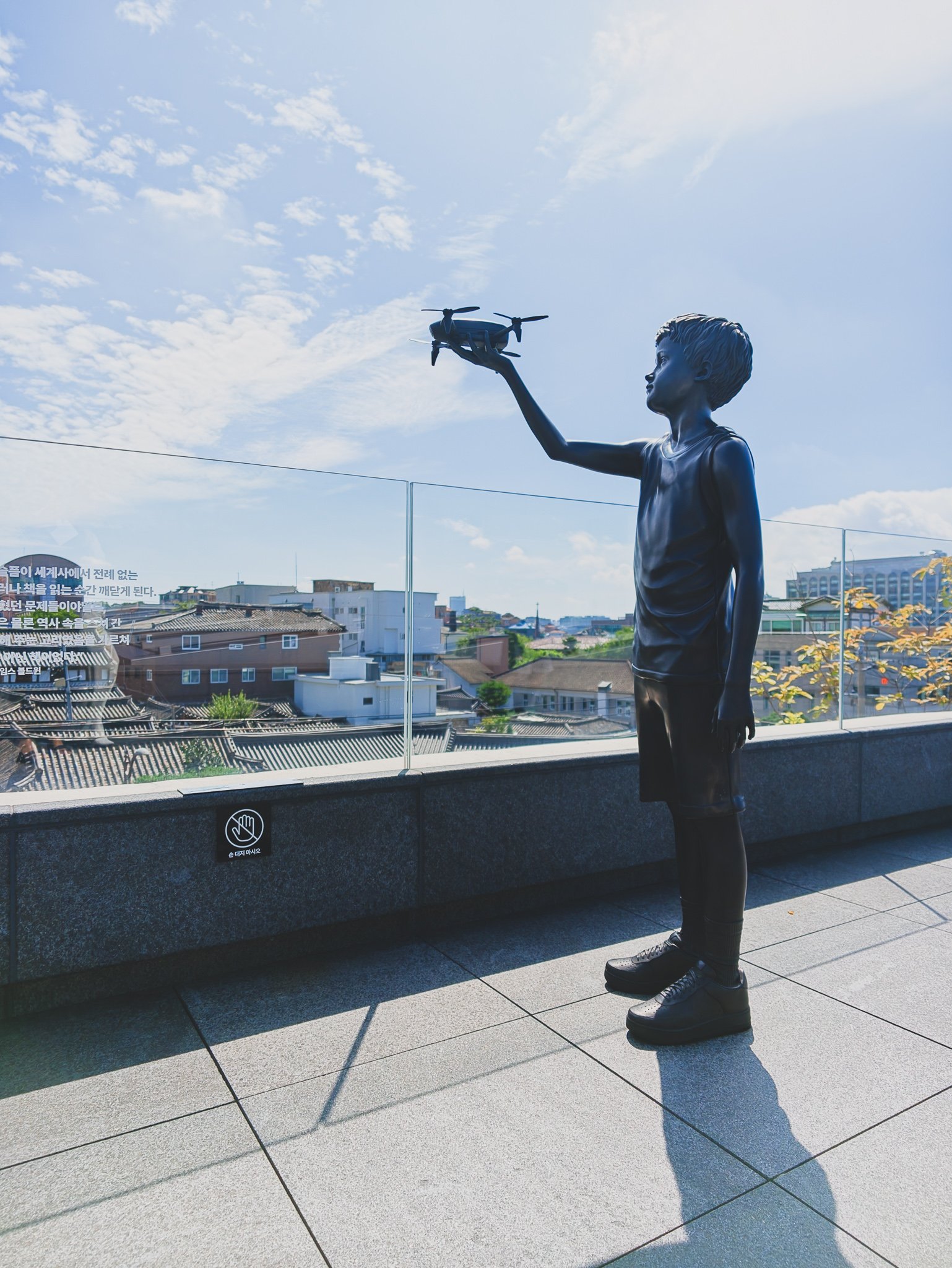
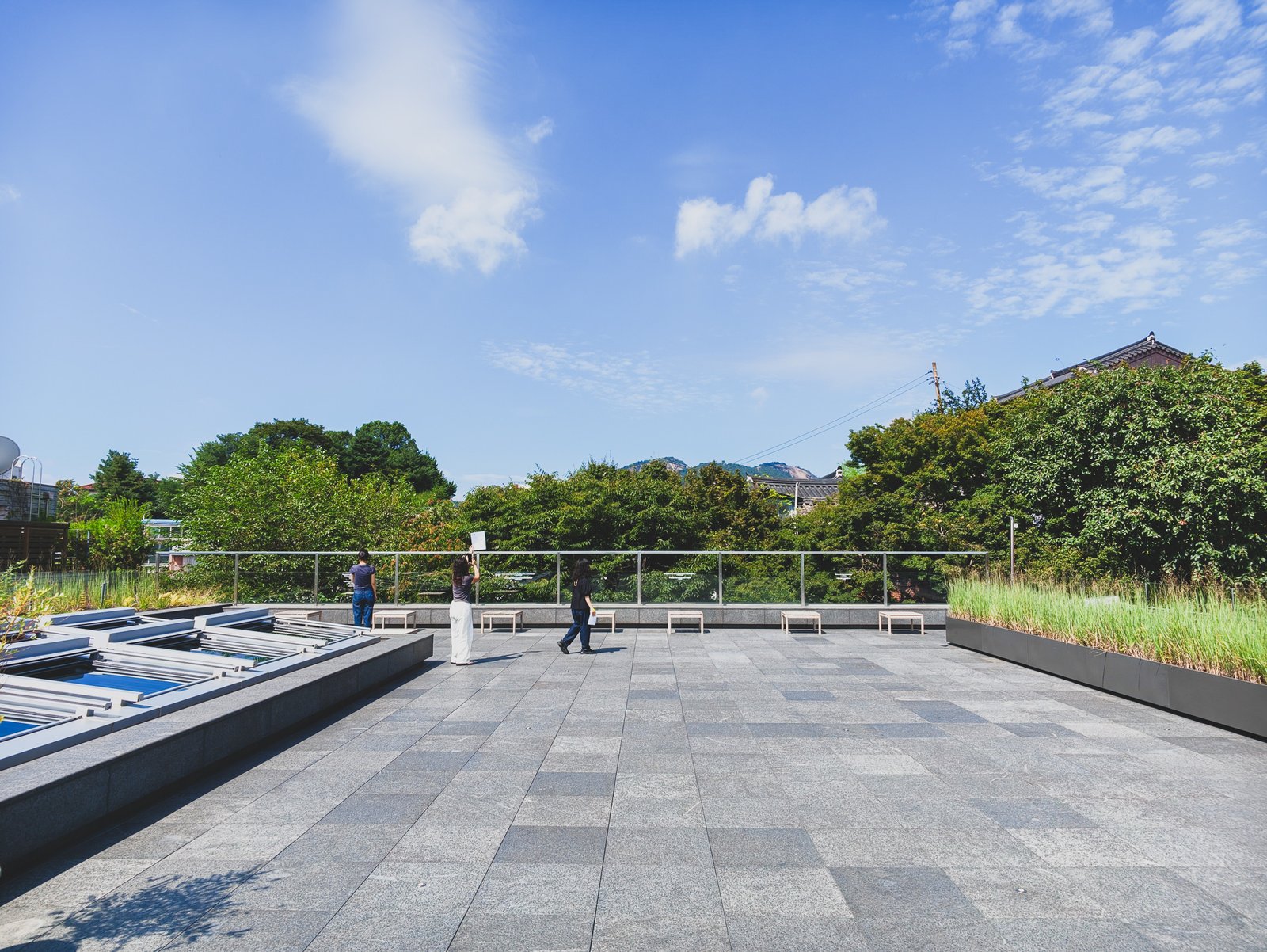
A boy-shaped sculpture holding a drone looks up at the skyline, with Bukchon’s tiled rooftops and the Namsan skyline framed behind it. A quote from Barbara Deming — “Our own pulse beats in every stranger’s throat” — is on the wall here, tying the opening theme of “coming home” back to a sense of connection with strangers. The final stretch is participatory: reading, listening to the artist’s voice, and leaving a trace of yourself in the space. There’s no need to rush out — sitting on a bench here for a few extra minutes in the open air is a good way to close out the visit.
Two honest downsides
Group entry means the mirror maze can get crowded. In the busiest sections, other visitors kept drifting into frame, which made it harder to get an uncluttered shot. This is a direct trade-off of the exhibition’s design — it’s built as a shared experience, not a quiet solo gallery walk — though slightly longer gaps between entry groups would probably help.
No cameras allowed inside. Every interior photo in this post was shot on a phone rather than a proper camera, since cameras aren’t permitted past the entrance. I wanted to capture the mirror maze’s infinite reflections and the library’s craftsmanship properly and simply couldn’t — so photos here undersell the actual sense of scale you get walking through it in person. Don’t judge this one by the photos; it’s built to be experienced, not just documented.
What the ticket info alone doesn’t tell you
Writing up the early-bird ticket details before visiting, I focused on the lineup of works and admission logistics. Walking through it in person, the real strength of this show isn’t any single installation — it’s the sequencing that connects them. A library that becomes a doorway, a mirror maze where not everything is actually a mirror, a reveal of the blueprint behind that illusion, a quiet room built entirely around one line of light, and a rooftop that opens the whole thing back up to the city — it reads as one continuous narrative rather than a collection of separate pieces. Given Devlin’s background in stage design, that sense of directed movement through the space feels intentional down to the last room.
FAQ
Q: Do I need to book a specific time slot?
A: Yes — entry is grouped and timed rather than free-flowing, so buy tickets in advance for your preferred time.
Q: Can I bring a camera?
A: No — cameras aren’t allowed inside. Phones are fine for photos.
Q: Is this good for a Bukchon date or itinerary stop?
A: Yes — it pairs naturally with a Bukchon hanok village walk, and the rooftop finale looks directly out over the neighborhood.
Q: How long does a visit take?
A: Budget at least an hour to move through all six sections without rushing, especially if you read the wall text.
Q: Is it very crowded?
A: Entry is capped per group, but the mirror maze section can still feel busy since everyone in your group moves through it together. Weekday mornings right after opening are your best bet for a quieter visit.
Q: Is there parking nearby?
A: No dedicated parking on-site — use a public lot near Bukchon-ro.
Bottom Line
If you’re already planning a Bukchon visit and want something more immersive than a typical gallery walk-through, this is worth building your schedule around — especially if you enjoyed Futura Seoul’s previous shows (Refik Anadol, Anthony McCall) or you care more about the feeling of a space than getting a perfect photo of it. If you’d rather view art quietly at your own pace, the timed group entry and the mirror maze’s crowds might feel like a mismatch — in that case, aim for a weekday slot right after opening.