TL;DR: Maison Baccarat Seoul on Dosan-daero reopened on September 2, 2026 after a full redesign by Harry Nuriev — Maison&Objet’s 2026 Designer of the Year. The ground floor is a free-to-enter crystal showroom (with price tags that run into the tens of thousands of dollars), and the second floor is Baccarat Bar Seoul, a members’-club-style cocktail bar where every drink is served in actual Baccarat crystal. A special Nuriev chandelier exhibition runs through October 12, 2026. No admission fee for the showroom; the bar has a real budget attached.
I’ll be upfront: this visit was hosted — Maison Baccarat Seoul invited me in for a space tour and a tasting the first weekend after their renewal reopened. I went on a Sunday evening, September 6, four days after the doors reopened, and left thinking about it far more than I expected to for what is, on paper, “a crystal store with a bar attached.”
Maison Baccarat Seoul & Baccarat Bar Seoul — Quick Facts
Address: 313 Dosan-daero, Gangnam-gu, Seoul (1st floor: Maison Baccarat Seoul; 2nd floor: Baccarat Bar Seoul)
Maison Baccarat Seoul (1F) hours: 11:00–20:00, showroom entry free
Baccarat Bar Seoul (2F) hours: 18:00–01:00 Sun–Thu, 18:00–02:00 Fri–Sat
Special exhibition: Harry Nuriev’s reimagined Zénith chandelier, on display through October 12, 2026
Parking: No dedicated lot — use nearby paid public parking
Getting there: Dosan-daero, a short walk from Apgujeongrodeo or Sinsa stations on Line 3
A 260-year-old crystal house hands the keys to a 2026 “Designer of the Year”
Luxury houses have gotten serious about turning their stores into destinations rather than just places to buy things — Hermès does it with pop-ups, Louis Vuitton with permanent exhibitions. Baccarat, the French crystal maison founded in 1764, is playing the same game with a full renewal of its Seoul flagship, reopened September 2, 2026, in collaboration with Harry Nuriev, the Russian-French designer named 2026 Designer of the Year at Maison&Objet.
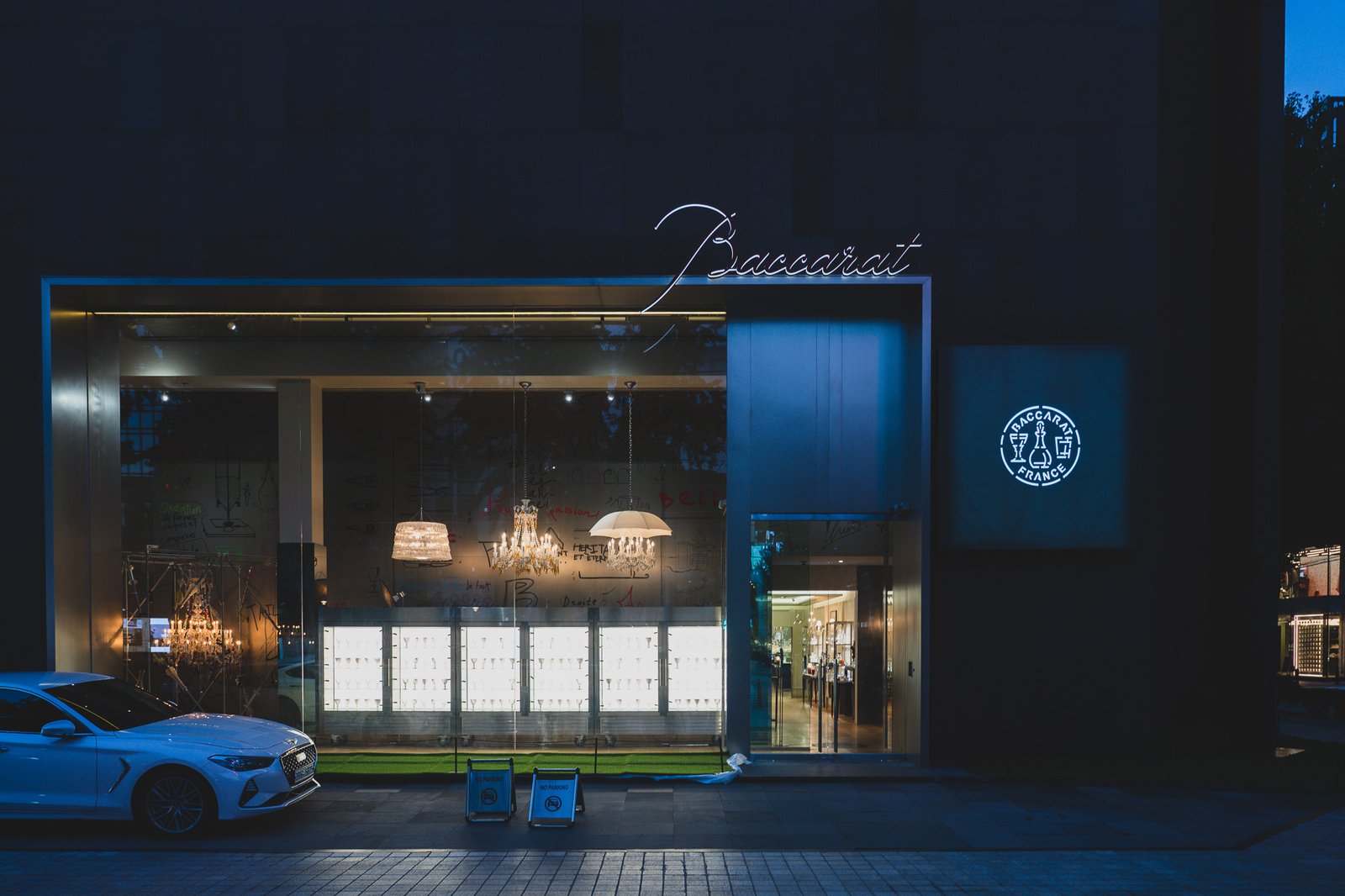
Walking up Dosan-daero after dark, the storefront is hard to miss — floor-to-ceiling glass with chandelier light spilling out onto the sidewalk. It’s the kind of window you’d stop for even if you had no idea what was inside.
The first thing you see through that glass is a one-of-a-kind reinterpretation of Baccarat’s signature Zénith chandelier, a design that dates back to around 1850. Nuriev’s version keeps the original crystal frame but hangs around 250 everyday objects from it — pens, keychains, a badminton racket, necklaces — instead of the usual crystal drops.
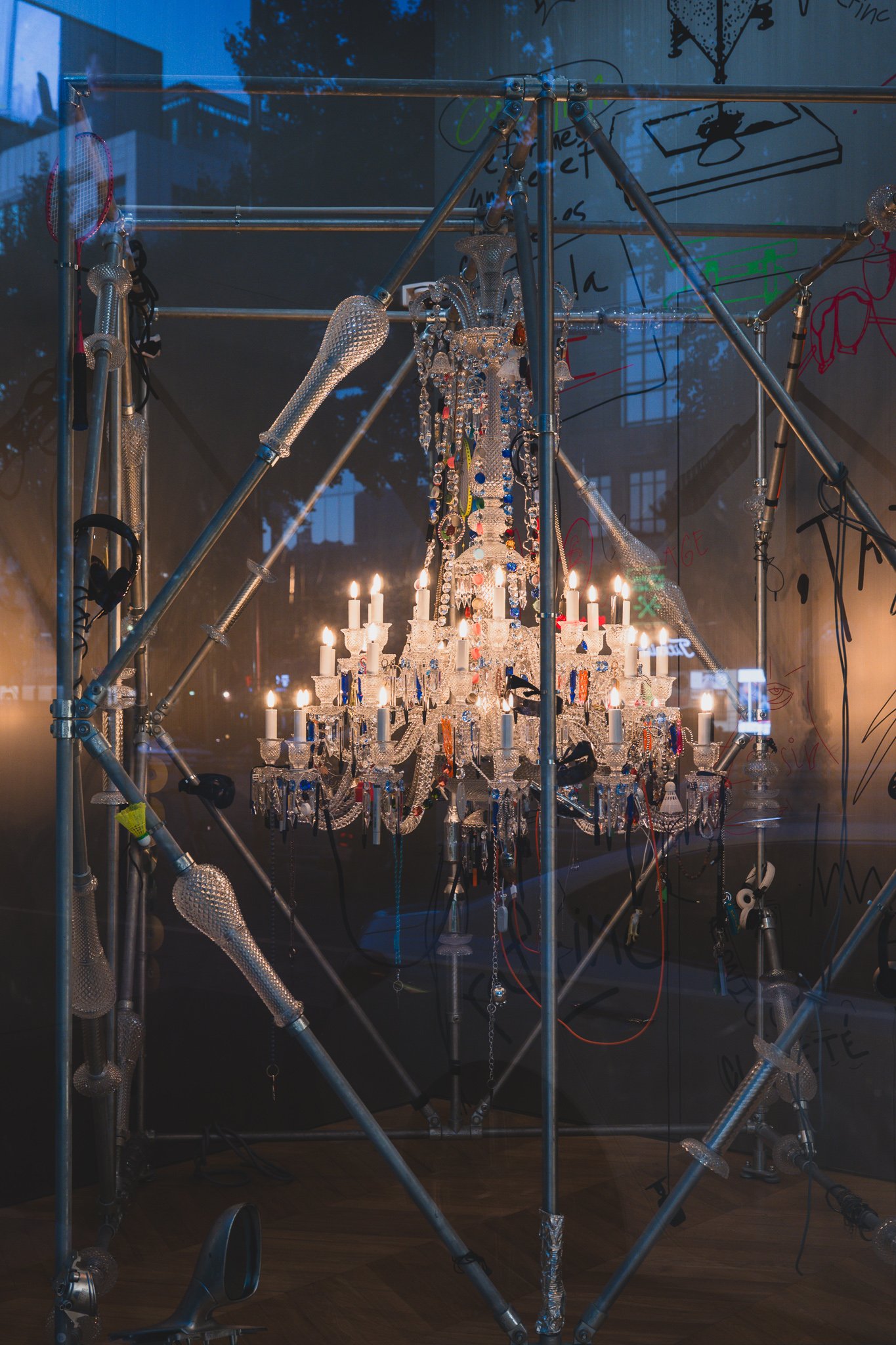
The concept, as it was explained to me: imagine a future where crystal is no longer available, and people fill in the missing pieces with whatever ordinary objects they have on hand. It’s a neat little thesis statement for Nuriev’s design philosophy, which he calls Transformism — respecting an object’s history rather than distorting it, and giving it new life instead. This particular piece is one of a kind and stays on view through October 12, 2026.
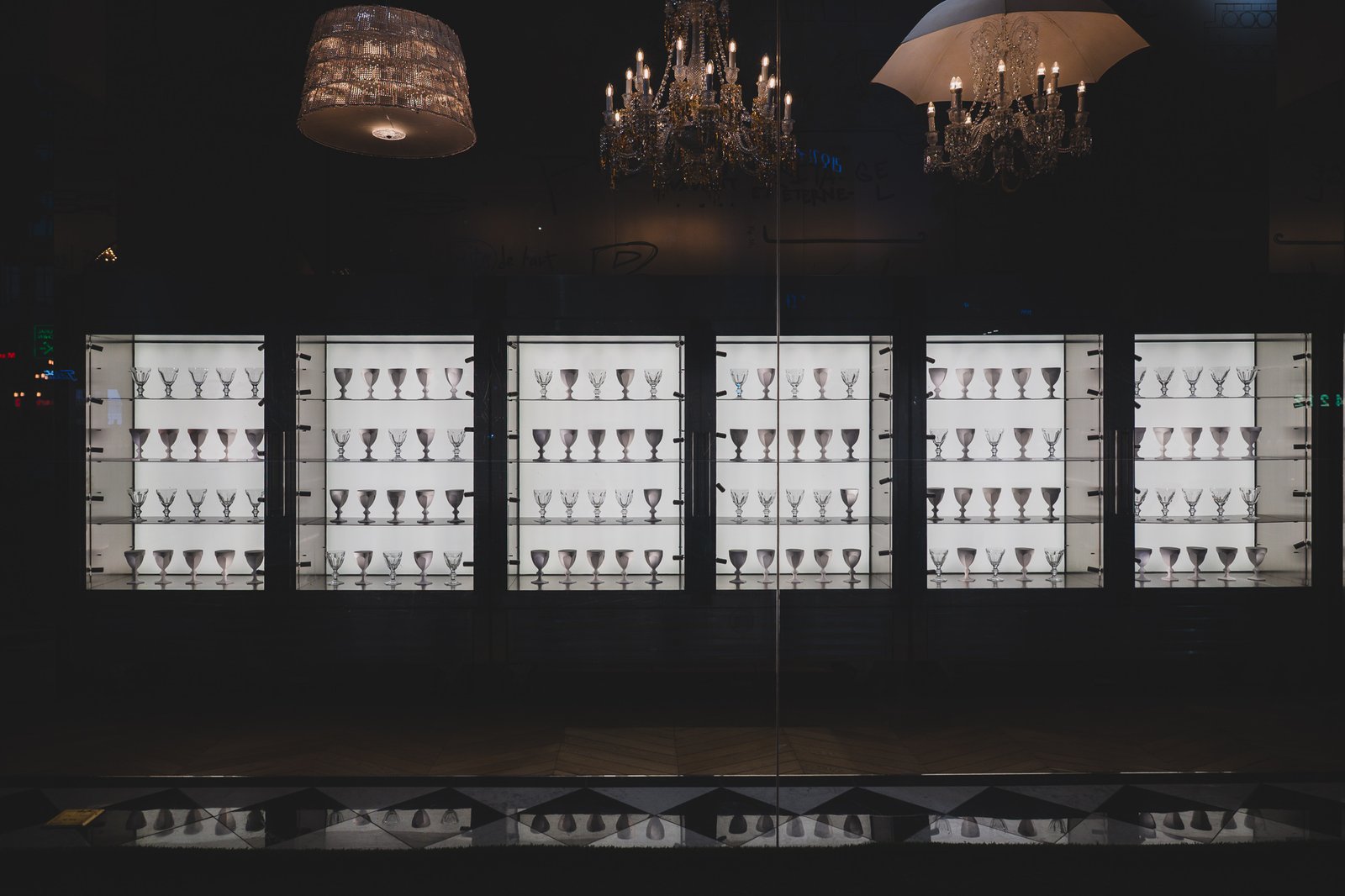
Next to it, a refrigerator-shaped display case is stacked with glasses from Harcourt 1841, Baccarat’s oldest and most iconic collection — the same faceted-stem glass you’ll see in old photos of French state dinners. Lining them up inside a “fridge” is a small, deadpan joke: cold industrial object, warm luxury object, frozen mid-scene.
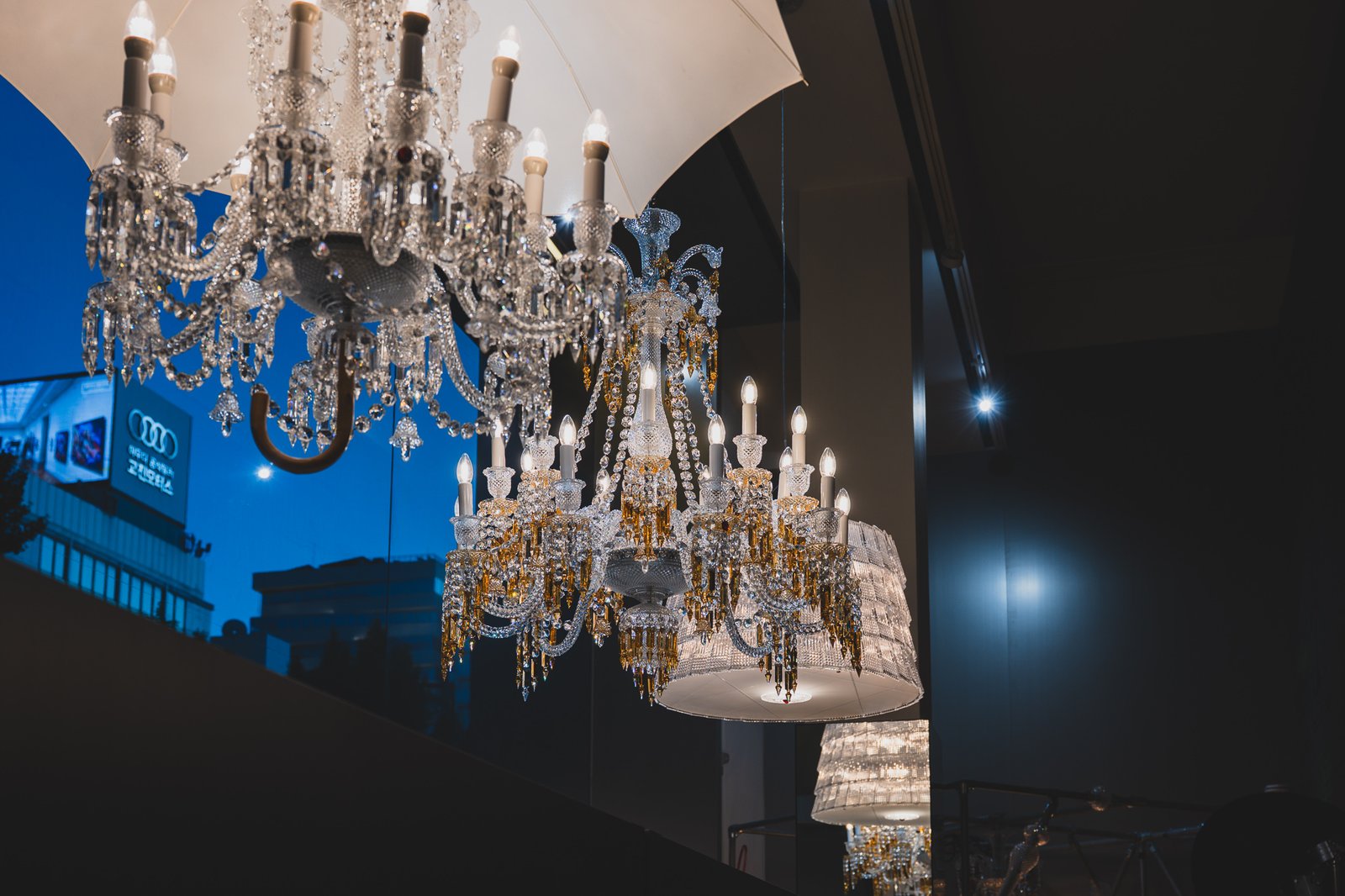
Past the entrance, the ceiling itself becomes the display — a cluster of chandeliers in wildly different styles, from umbrella-shaped shades to classic tasseled crystal to pieces streaked with amber.
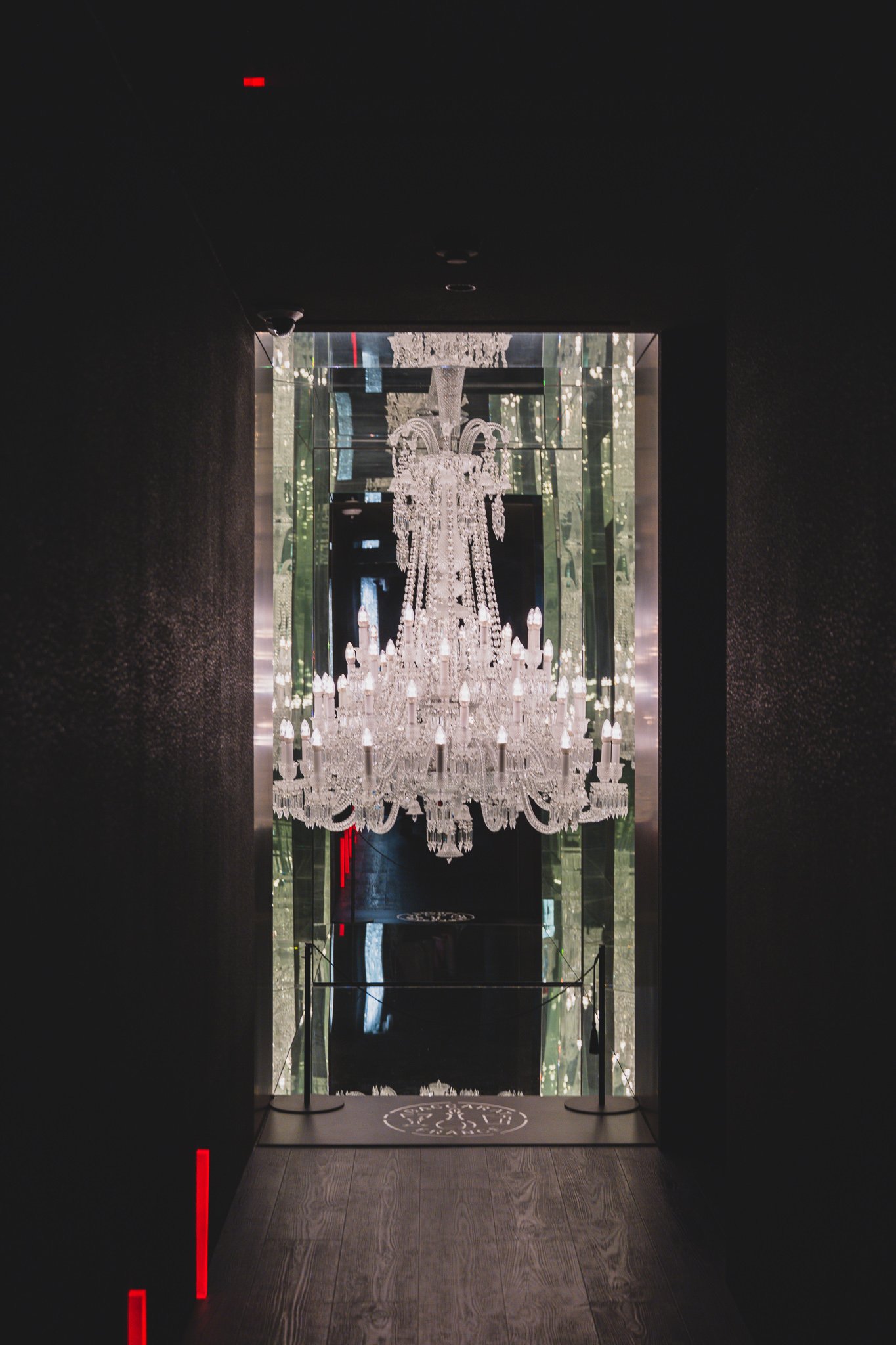
At the center of the ground floor, a large chandelier hangs over a mirrored corridor, its reflection bouncing back and forth until it looks like it goes on forever. Nearly everyone who walked through while I was there stopped to take a photo at exactly this spot.
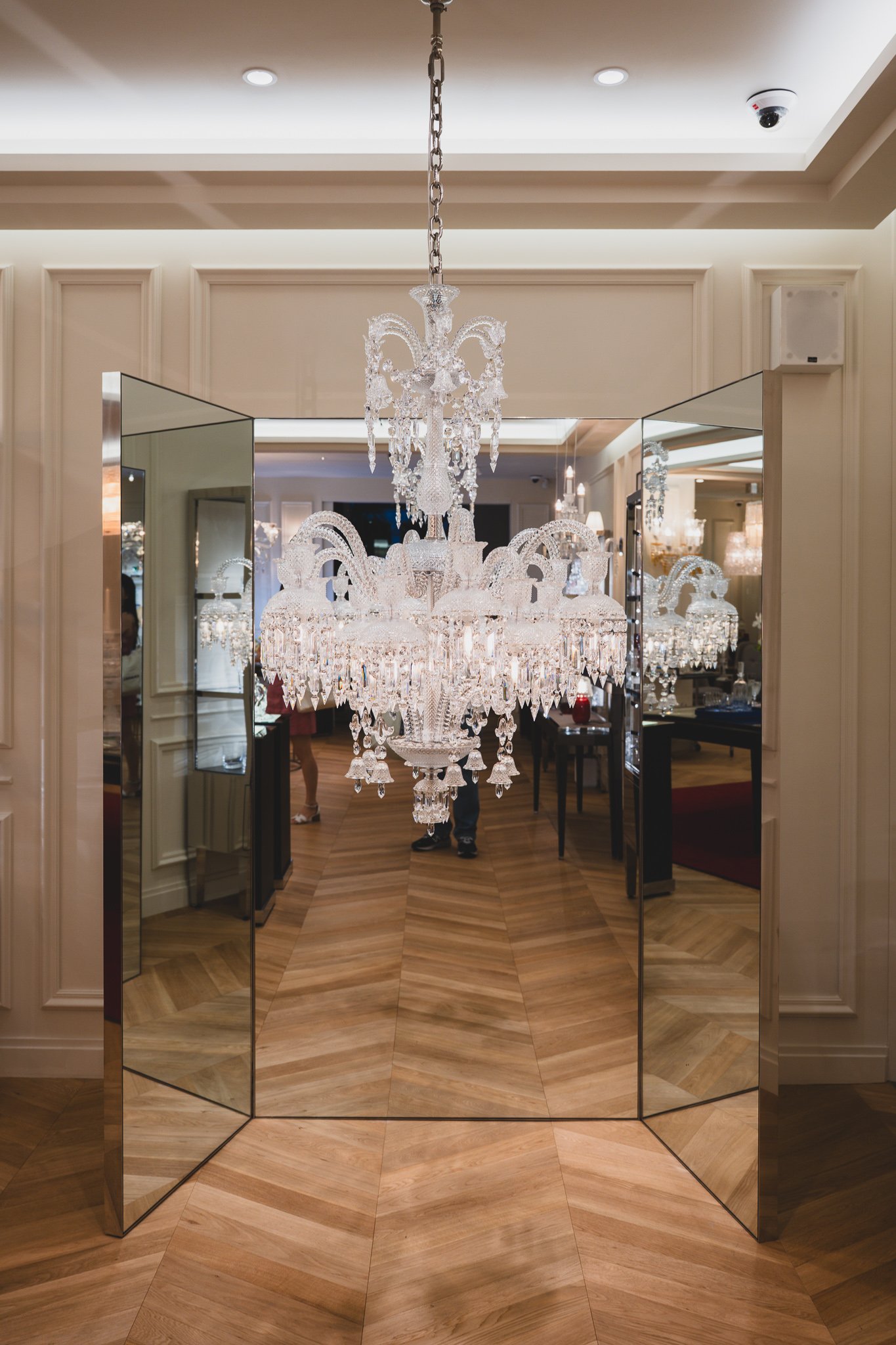
The ground floor showroom: prices that will make you gasp
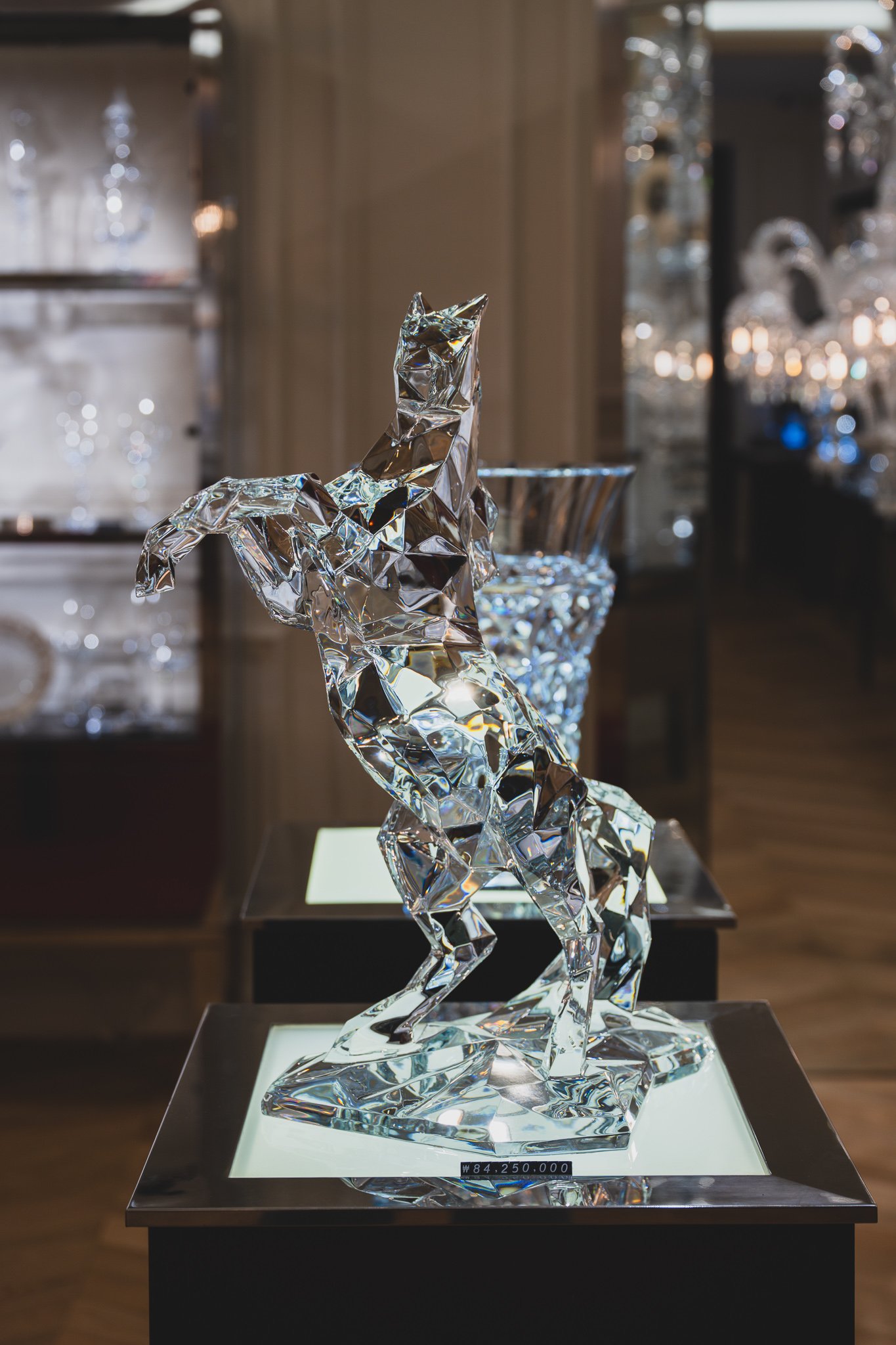
Scattered around the first floor are heritage pieces meant to show off what Baccarat crystal can actually do, and the price tags are part of the show. (Conversions below are rough, using roughly ₩1,400 to the dollar.)
A crystal horse rearing on its hind legs is priced at ₩84,250,000 — about $60,000. It’s genuinely startling to see crystal cut into a shape with this much motion in it.
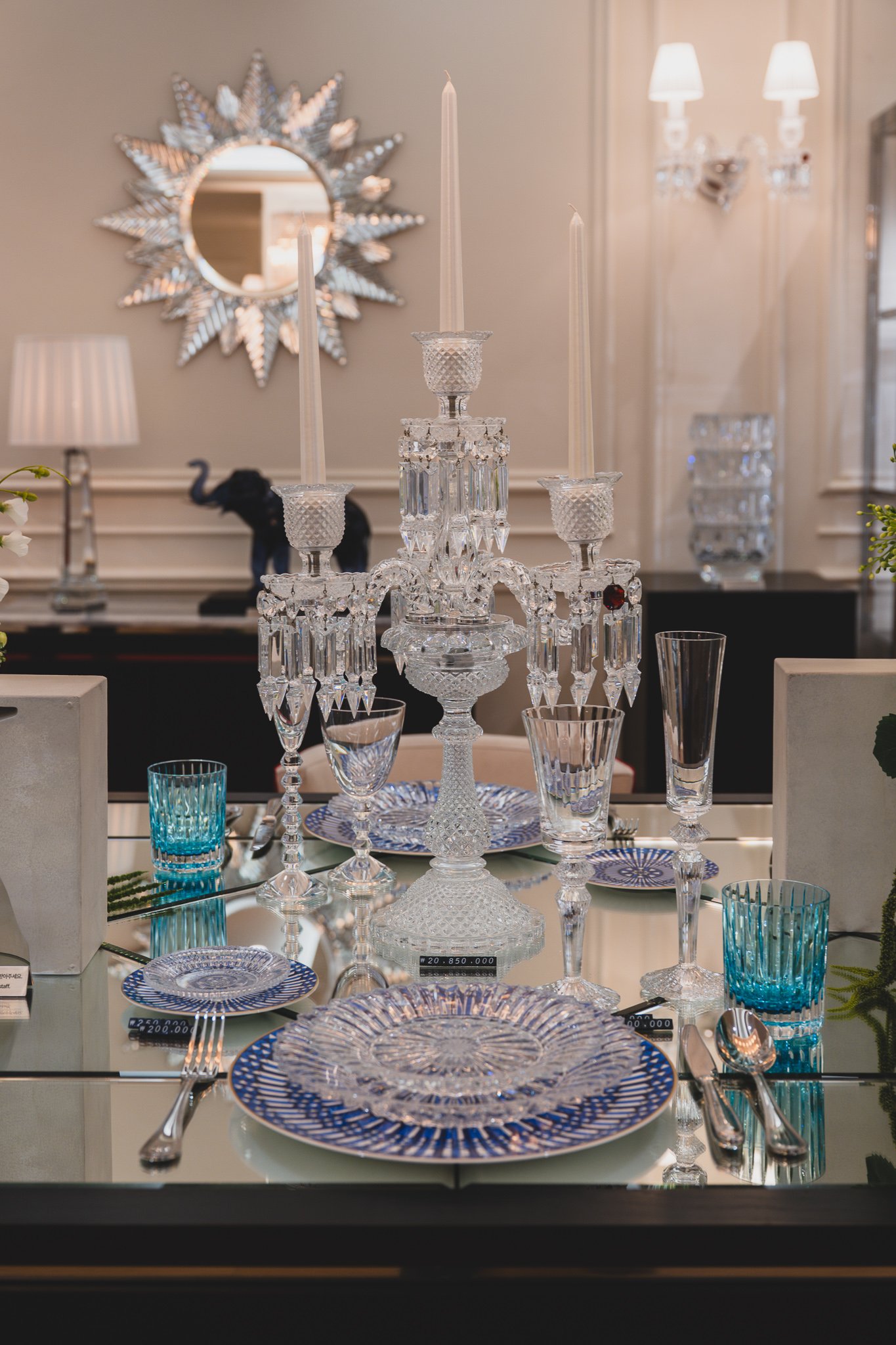
The piece I kept coming back to was a full dining table set in blue and white — a crystal candelabra alone priced in the low-₩20-millions (roughly $14,000), surrounded by cobalt-patterned tumblers and matching plates. It’s staged like an actual dinner party, and it’s hard not to picture sitting down at it.
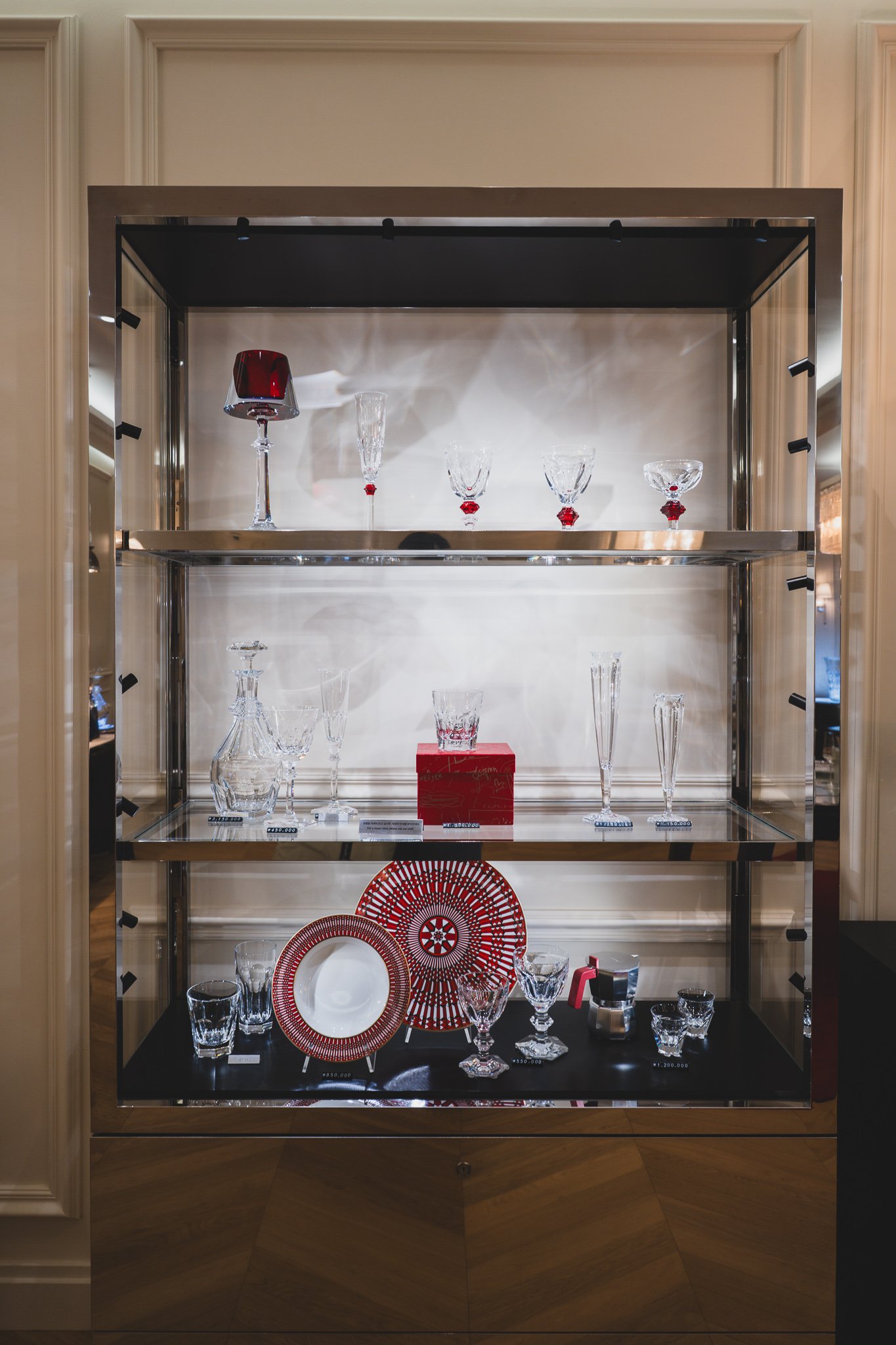
A cabinet nearby holds crystal tumblers and decanters in red, blue, and green — even a crystal-handled moka pot. Baccarat clearly does more with color than the “clear crystal only” image most people (myself included) walk in with.
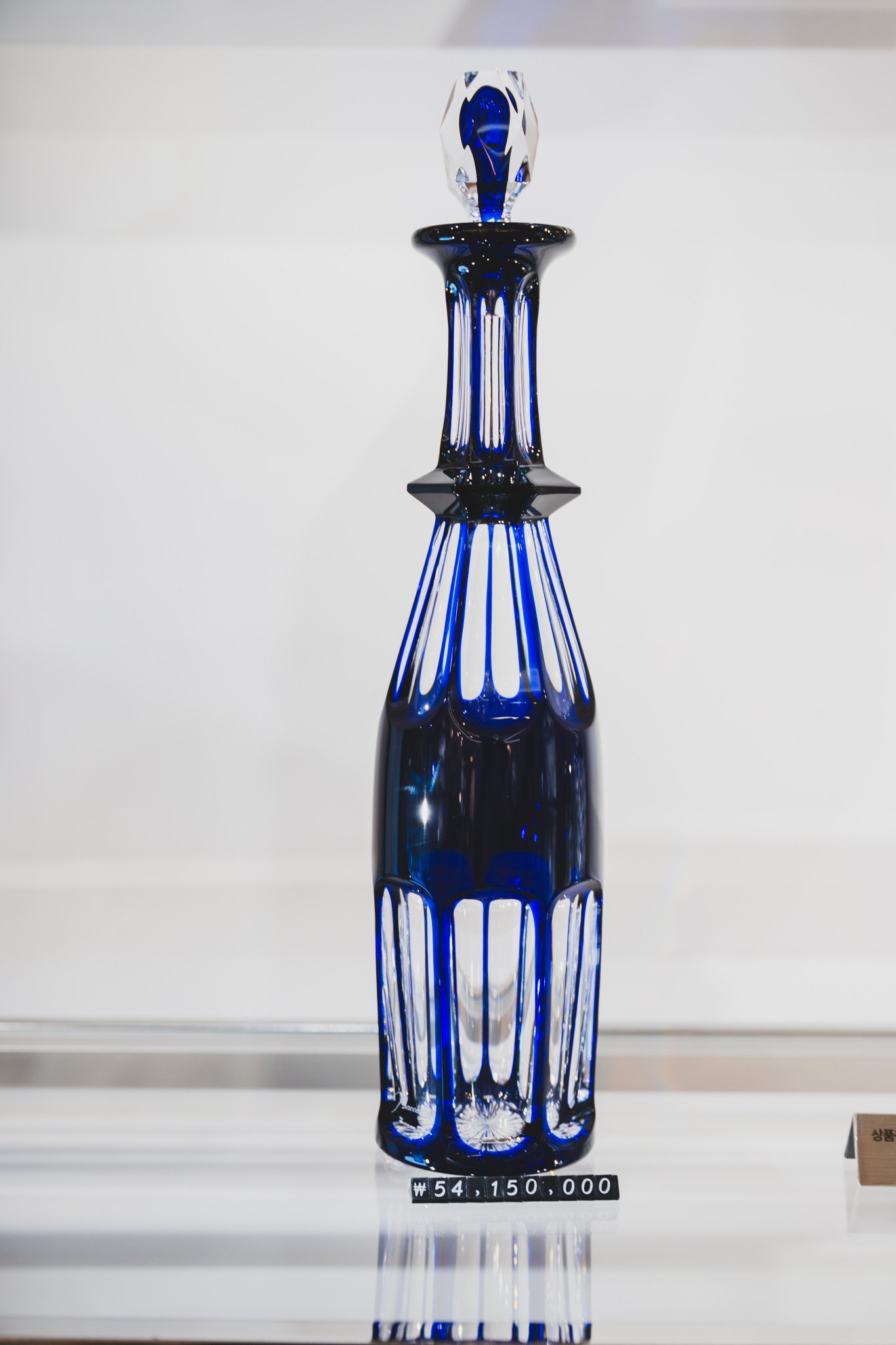
At the very back, a cobalt-blue crystal decanter catches the spotlight — ₩54,150,000, or roughly $38,700. By this point in the room, the prices stop registering as prices and start registering as “so this is apparently something people make.”
Upstairs, the theory becomes a drink: Baccarat Bar Seoul
If the first floor is about looking at the brand’s heritage, the second floor is about using it. A narrow, mirror-lined corridor leads up a staircase to Baccarat Bar Seoul — and the corridor alone does a lot of work building anticipation before you even reach the bar.
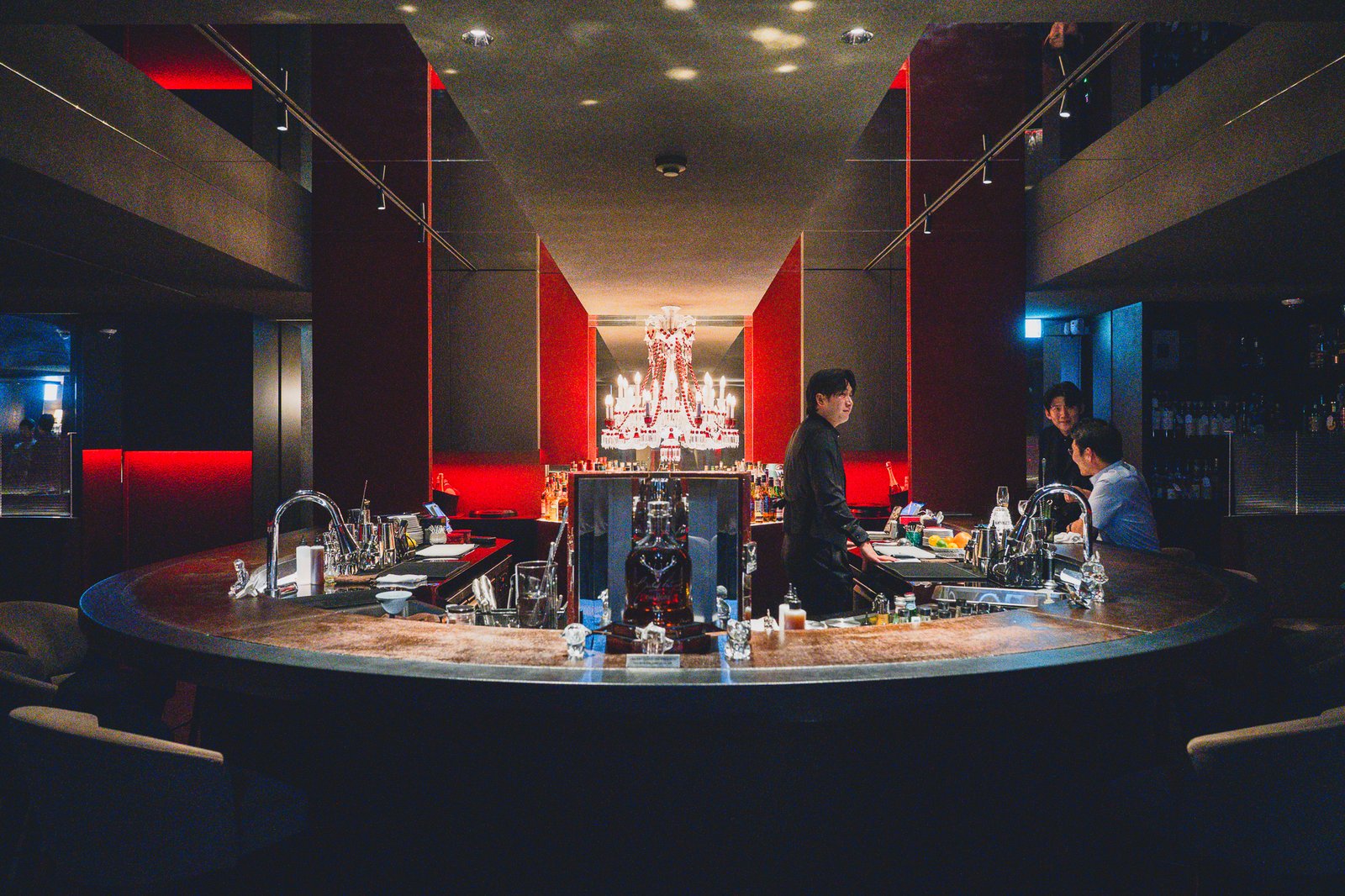
The second floor is split into a bar counter, a hall seating area, and two private rooms. The round bar counter sits under red lighting and a crystal chandelier — less “having a drink” and more “sitting on a small stage.”
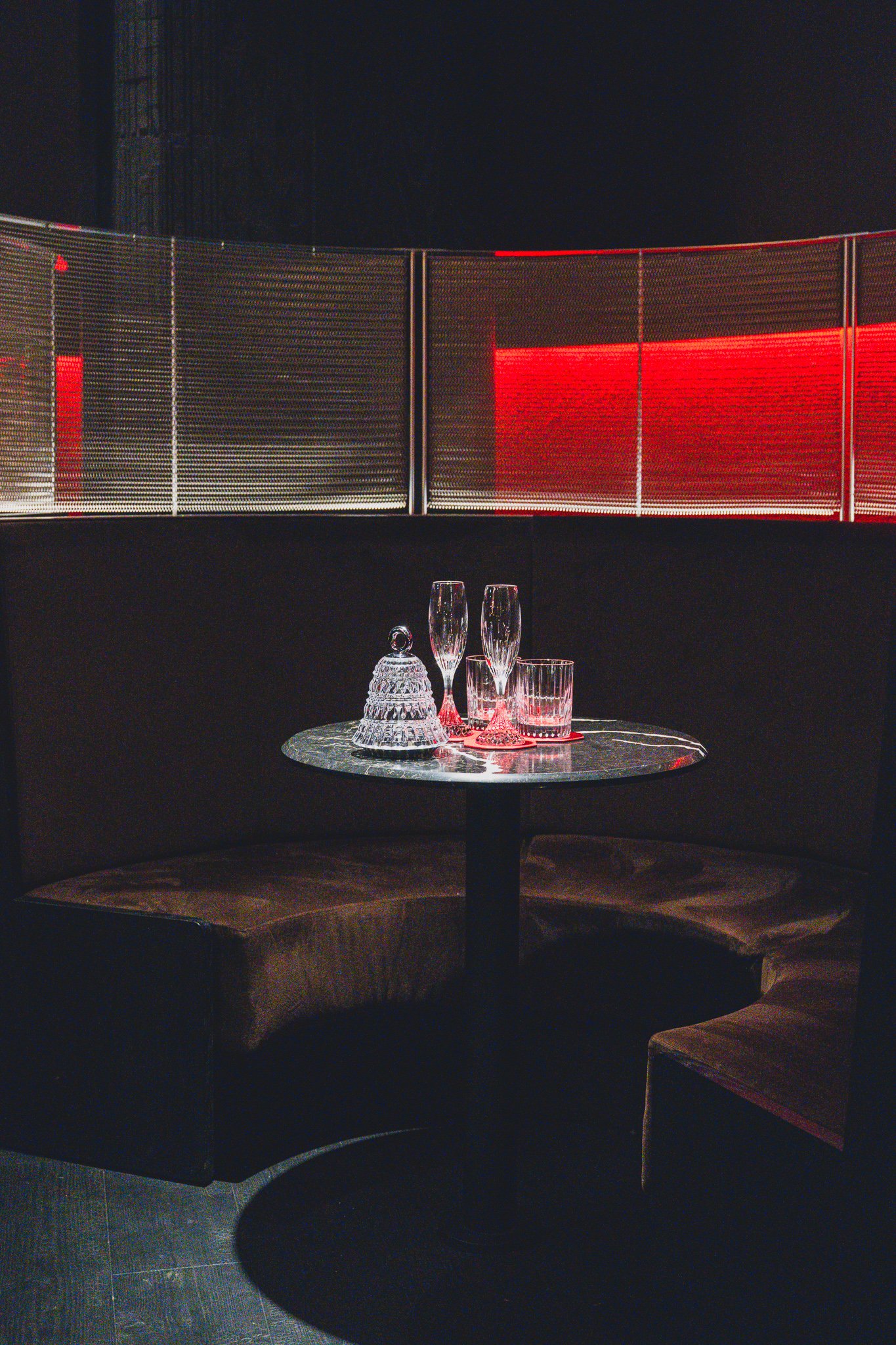
Past the bar, a semicircle of sofas wraps around low tables for a more relaxed setup than the counter.
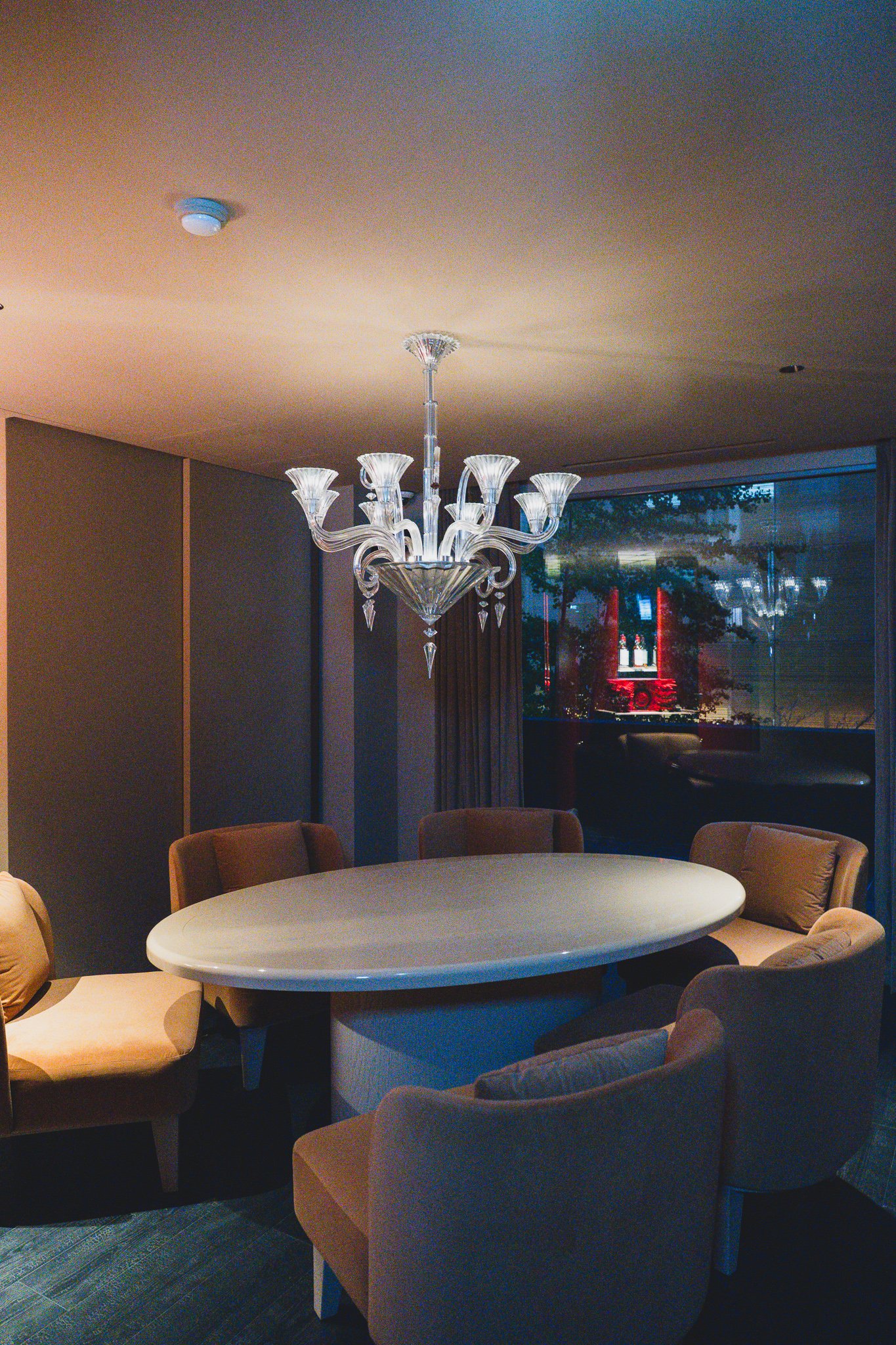
The two private rooms couldn’t be more different from each other. One is bright and warm — a white oval dining table, brown leather armchairs, and a crystal chandelier hung low, built for a group that wants to eat and drink together.
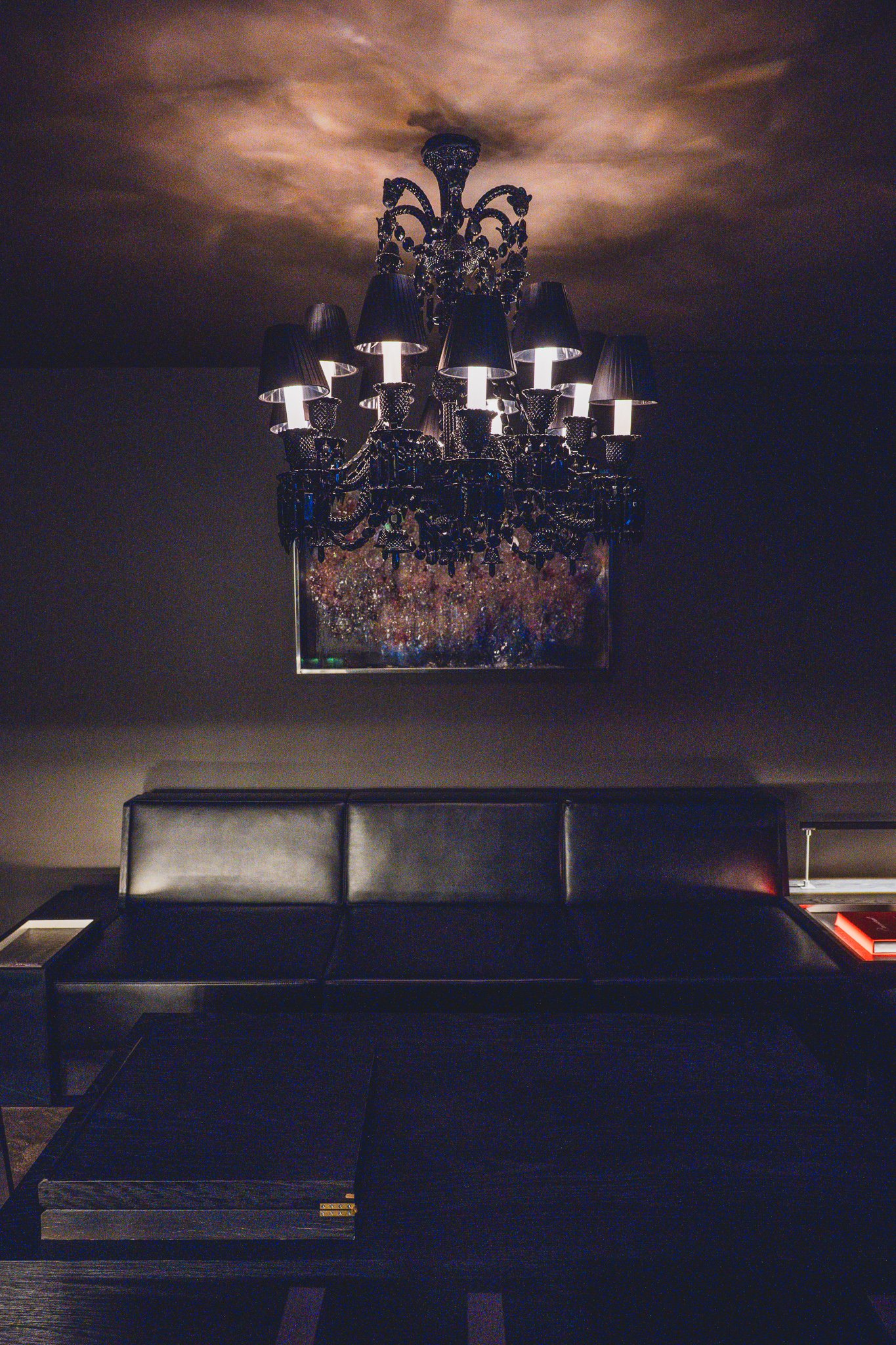
The other goes full moody lounge: a black crystal chandelier over dark leather sofas, lighting dialed way down. On the wall hangs an art piece that turned out to be the room’s quiet highlight — “Gathering,” a 2026 mixed-media work by Korean artist Jeehui Hong, made from glass fragments in blue, red, white, and black (colors meant to represent Korea and France) set against Baccarat crystal light. Nobody on the tour mentioned it up front; I noticed it on my own, which somehow made it a better find.
I asked staff about the room policy: there’s no separate room charge, just a ₩1,000,000 minimum spend (roughly $710) per room, which works out reasonably if you’re a group of four to six. Worth knowing before you go: since the glassware is real Baccarat crystal, breakage is charged at 50% of retail price — generous given how expensive these glasses actually are, but it’s still enough to make you hold your cocktail a little more carefully than usual.
What’s actually in the glass: tasting “Lost & New”
The menu sets the tone before you even order — a Dalmore x Baccarat line pours The Dalmore 45 from a Baccarat-made bottle, and a cocktail called “Tsar, the Emperor” mixes Louis XIII cognac with caviar and truffle, limited to three glasses a day.
What I actually tasted was “Lost & New,” a cocktail built around Nuriev’s Transformism concept — gin, chamomile, strawberry syrup, chamgoe (Korean melon), and tonic water. The blue streak in the glass is strawberry; the pink is a melon mousse.
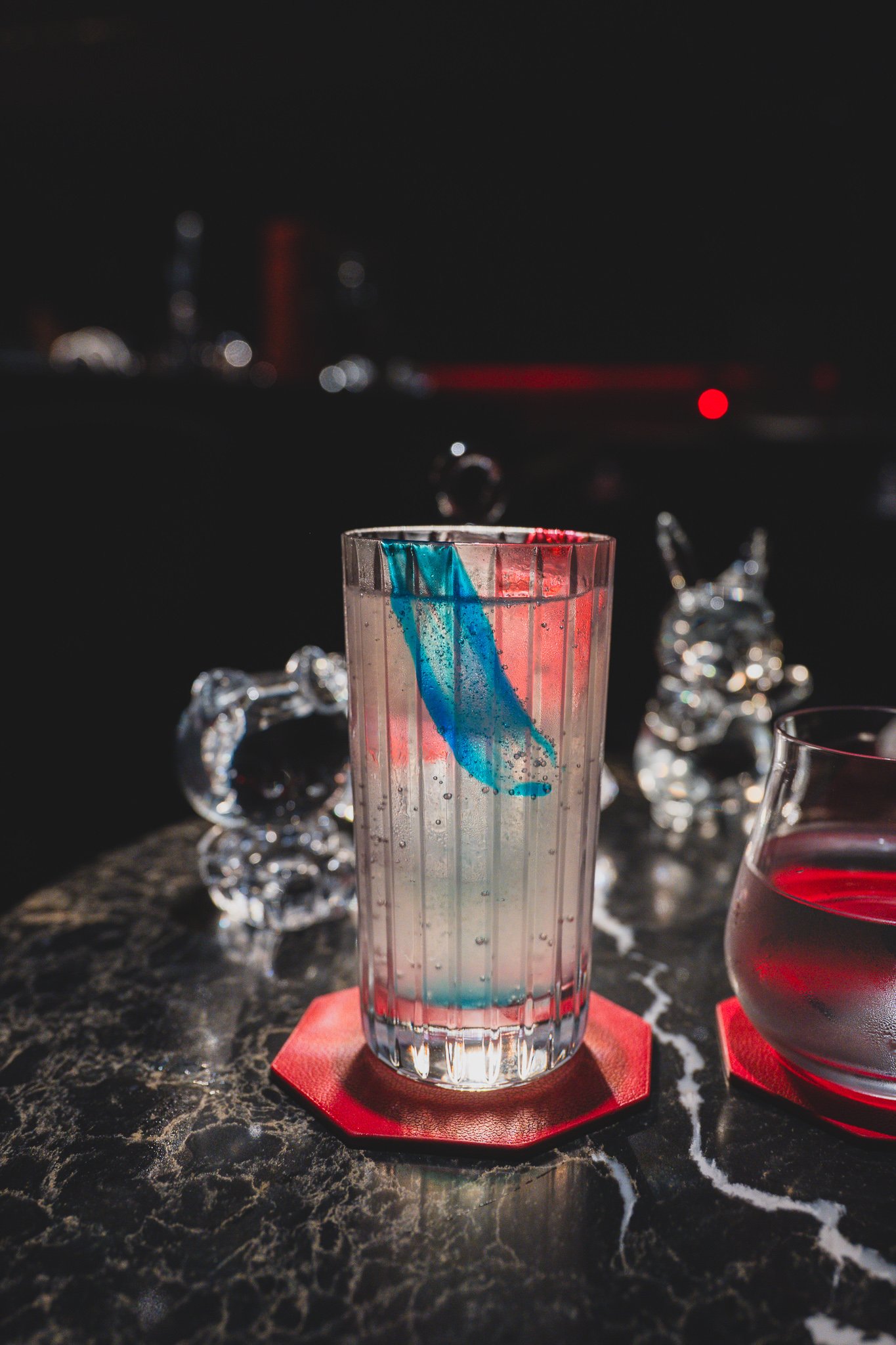
It looks a lot louder than it tastes. Juniper and a light herbal chamomile note come first, followed by a faint, not-too-sweet trail of strawberry and melon — easy to keep drinking without it turning cloying. The idea, as it was pitched to me, is applying Nuriev’s “give ordinary things new meaning” philosophy to two unglamorous summer fruits, remixed into an unfamiliar pairing. Knowing that going in made each sip land a little differently.
While waiting on the drinks, I noticed a small lineup on the bar counter: crystal figurines of Hello Kitty and Pikachu, played completely straight. Carving a cartoon character out of crystal with this much seriousness is funny in a way that somehow still reads as tasteful.
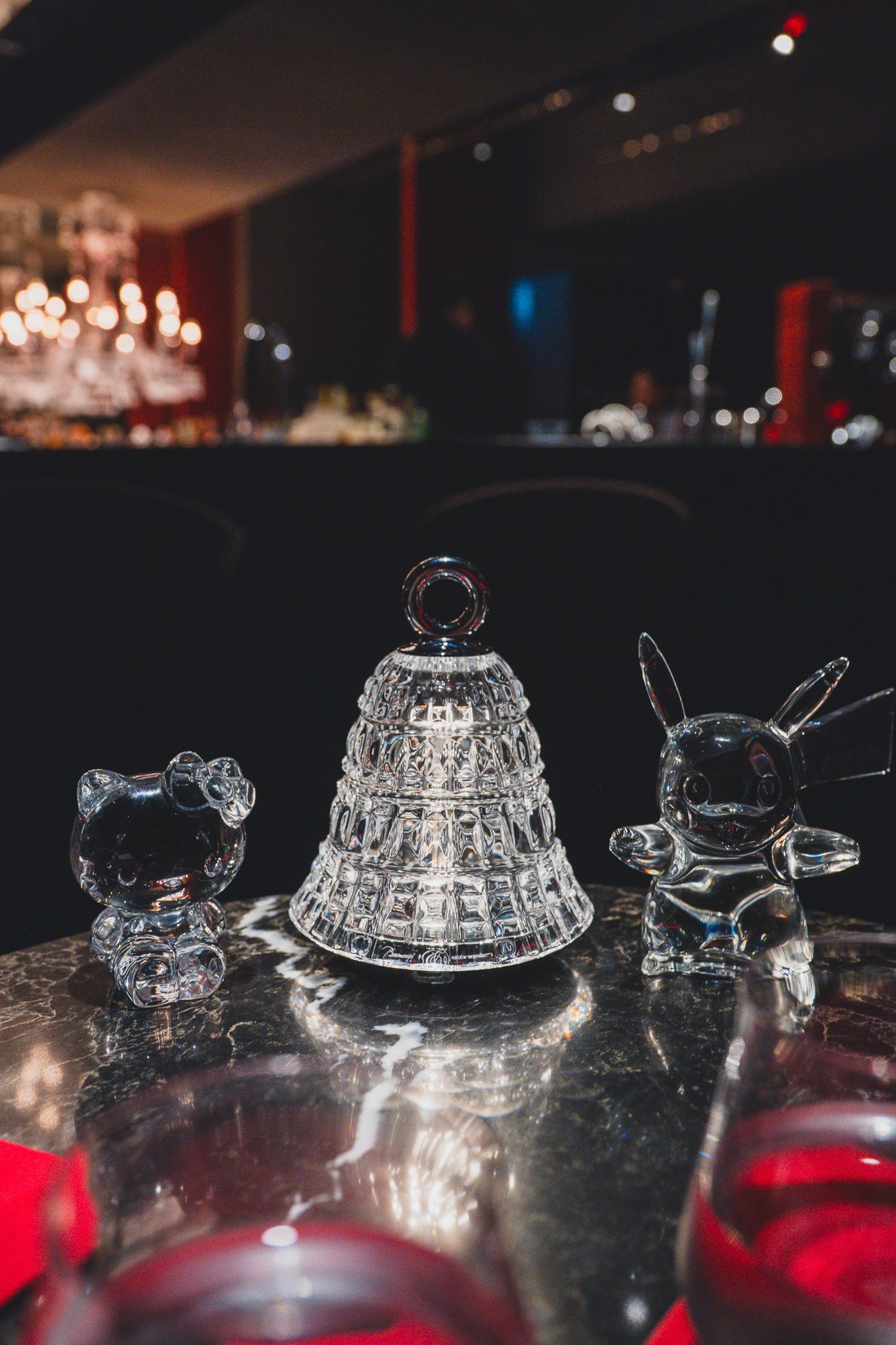
Drinking a cocktail out of an actual Baccarat crystal glass is a strange feeling in itself — this is the kind of glass you’d normally only see behind a display case, and here you’re holding one, using it as intended. The chandeliers scattered around the bar make even the ambient lighting feel deliberate; I was told one of the table lamps alone runs about ₩2,800,000 (roughly $2,000), and once you know that, the cut-crystal shadow pattern it throws on the wall looks a lot more romantic.
One more detail worth mentioning: the bartender who made my drink previously spent years as head bartender at Alice, Cheongdam, a well-known Seoul cocktail bar. It showed — for a visually loud drink, the balance held up cleanly from first sip to last.
Is it worth going?
Stepping back, this renewal isn’t really about redecorating a store. A 260-year-old luxury crystal house has to widen its points of contact to stay relevant — most people simply don’t buy a crystal vase every year. So Baccarat brings in a contemporary designer for a headline collaboration, and puts an actual cocktail bar on the second floor so people can buy “the experience of drinking from a Baccarat glass” instead. That’s a much lower bar to entry than buying the vase, and it compounds — the next time someone’s actually in the market for crystal, there’s a decent chance they remember the bar, not a competitor’s showroom.
That said, this isn’t a casual drop-in spot. Signature cocktails aren’t cheap, and the private rooms carry that ₩1,000,000 minimum. It’s better suited to a special occasion than a random Tuesday — a milestone date night, an engagement dinner, a small pre-wedding gathering, or an evening entertaining visitors from abroad who’d appreciate seeing French crystal heritage and Korean bar culture collide in one room.
FAQ
Do I need to pay to enter Maison Baccarat Seoul?
No — the ground-floor showroom is free to browse, no reservation needed, 11:00–20:00 daily.
Do I need a reservation for Baccarat Bar Seoul?
The bar counter and hall seating can take walk-ins depending on availability; the two private rooms are best booked ahead given the ₩1,000,000 minimum spend policy.
How much does a cocktail cost at Baccarat Bar Seoul?
Regular cocktails are priced at typical high-end Seoul bar rates; the ultra-premium signature pours (like the Louis XIII-based “Tsar, the Emperor”) are limited to three glasses per day and priced accordingly.
What happens if I break a glass?
Staff quote breakage at 50% of the glass’s retail price — steep in absolute terms, but a real discount given these are genuine Baccarat crystal pieces.
How long does the Harry Nuriev chandelier exhibition run?
The reinterpreted Zénith chandelier is on view through October 12, 2026, on the ground floor.
Is Baccarat Bar Seoul only for hotel guests or members?
No — it’s open to the public, though the atmosphere (and price point) lean toward a special-occasion crowd rather than casual walk-ins.
Bottom Line
Maison Baccarat Seoul’s renewal is worth the visit for the free ground-floor showroom alone — it’s less “store” than a compact museum of what crystal can do, redesigned by one of 2026’s most talked-about designers. But the real reason to make a reservation is upstairs: Baccarat Bar Seoul turns “look, don’t touch” into an actual evening out, crystal glass in hand.