TL;DR: A prepaid travel card (Travel Wallet, Traveloger, WOWPASS) loaded before or right after you land is the easiest way to get a fair rate in Korea, with little to no markup on major currencies. If you want cash, skip the airport exchange counters — they run 3–5% worse than the mid-market rate — and use a neighborhood money changer instead. I photographed one in Seongsu on September 8, 2026: its board read 1,335 KRW per USD against a mid-market rate of 1,342.87, a spread of about 0.6%. ATMs work too, but foreign-card withdrawal fees (₩2,000–4,500 per transaction, plus whatever your home bank adds) make them the priciest option for small amounts.
Figuring out how to actually get Korean won trips up a lot of first-time visitors, mostly because there’s no single “best” answer — it depends on whether you want cash in hand or a card you can tap everywhere. I ended up using a Travel Wallet card for most of my trip, and it made this whole question a lot less stressful than I expected going in. But I also walked into a real exchange shop and photographed the board, because “get a good rate” is useless advice unless you know what a good rate actually looks like on the screen.
Method 1: Prepaid Travel Cards (Travel Wallet, Traveloger, WOWPASS)
This is the option I’d actually recommend starting with. You load foreign currency (USD, EUR, etc.) onto an app-linked card before or during your trip, and it converts to KRW at a rate that’s close to the real mid-market rate — no haggling, no counting cash, no guessing whether you’re getting ripped off.
My experience with Travel Wallet: I used a Travel Wallet card for most of my purchases and the exchange rate was noticeably good — close enough to the mid-market rate that I didn’t feel like I was losing money on every transaction the way you do with a bank card abroad. Travel Wallet advertises 0% currency exchange fees on major currencies like USD, JPY, and EUR, with preferential rates and no international payment fees, and that matched what I actually experienced. It supports 40+ currencies, so it’s not just a Korea-specific tool if you’re continuing on elsewhere.
Other options in the same category:
– Traveloger (from Hana Bank) works on a similar prepaid, pre-loaded model — load currency, spend and withdraw in Korea at competitive rates.
– WOWPASS is a bit different: it’s a combined prepaid debit card + T-money transit card, so it also works on buses and the subway. You load it in foreign cash directly at WOWPASS kiosks (found at the airport and around the city) or via the app, and it converts at a rate that’s consistently better than airport exchange counters. There’s a small ₩1,000 fee if you cash out your remaining balance at the end of your trip, and a ₩3,000 fee if you need to reissue a lost card, but loading and spending is fee-free. WOWPASS supports 16 currencies including USD, EUR, JPY, and CNY.
Set-up for all of these is basically the same: download the app before you land, verify your identity, and either load money in advance or top up once you’re at a WOWPASS kiosk or Travel Wallet-linked ATM in Korea.
Method 2: Currency Exchange Shops
If you want physical cash — and you’ll want at least some, since a few small vendors and traditional markets are still cash-only — where you exchange it matters more than most tourists realize.
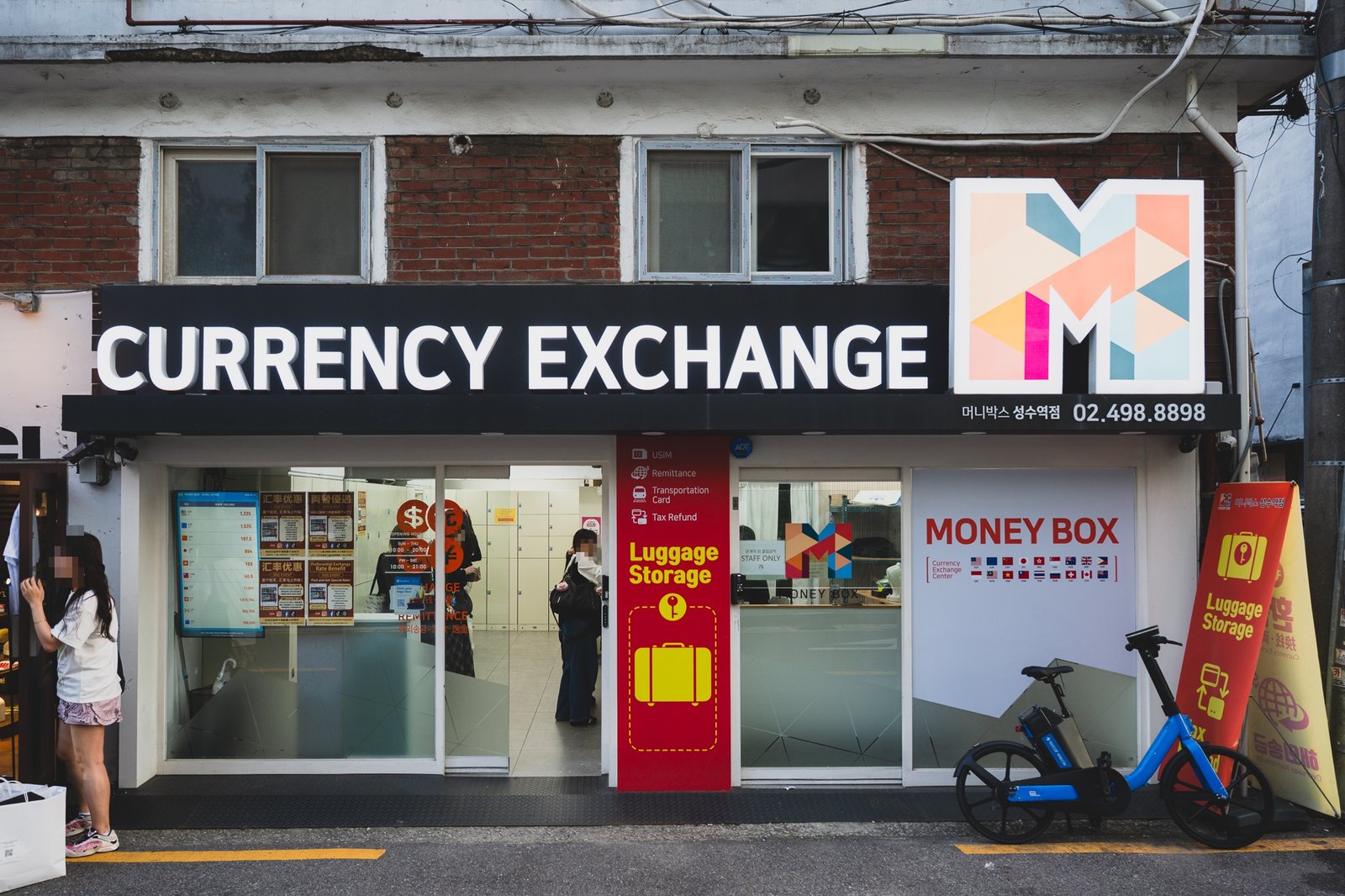
What a neighborhood exchange shop actually looks like. Forget the image of a back-alley kiosk — the ones tourists use are storefront operations on ordinary shopping streets, with the day’s rates on a screen facing the sidewalk. This is Money Box’s Seongsu Station branch (머니박스 성수역점), about a minute from Seongsu Station Exit 4 at 16 Yeonmujang 5-gagil, Seongdong-gu. It’s open Sunday to Thursday 10:00–20:00 and Friday to Saturday 10:00–21:00. Shops like this are government-registered, they post their rates publicly, and the rate on the board is the whole price — there’s no separate commission tacked on at the counter.
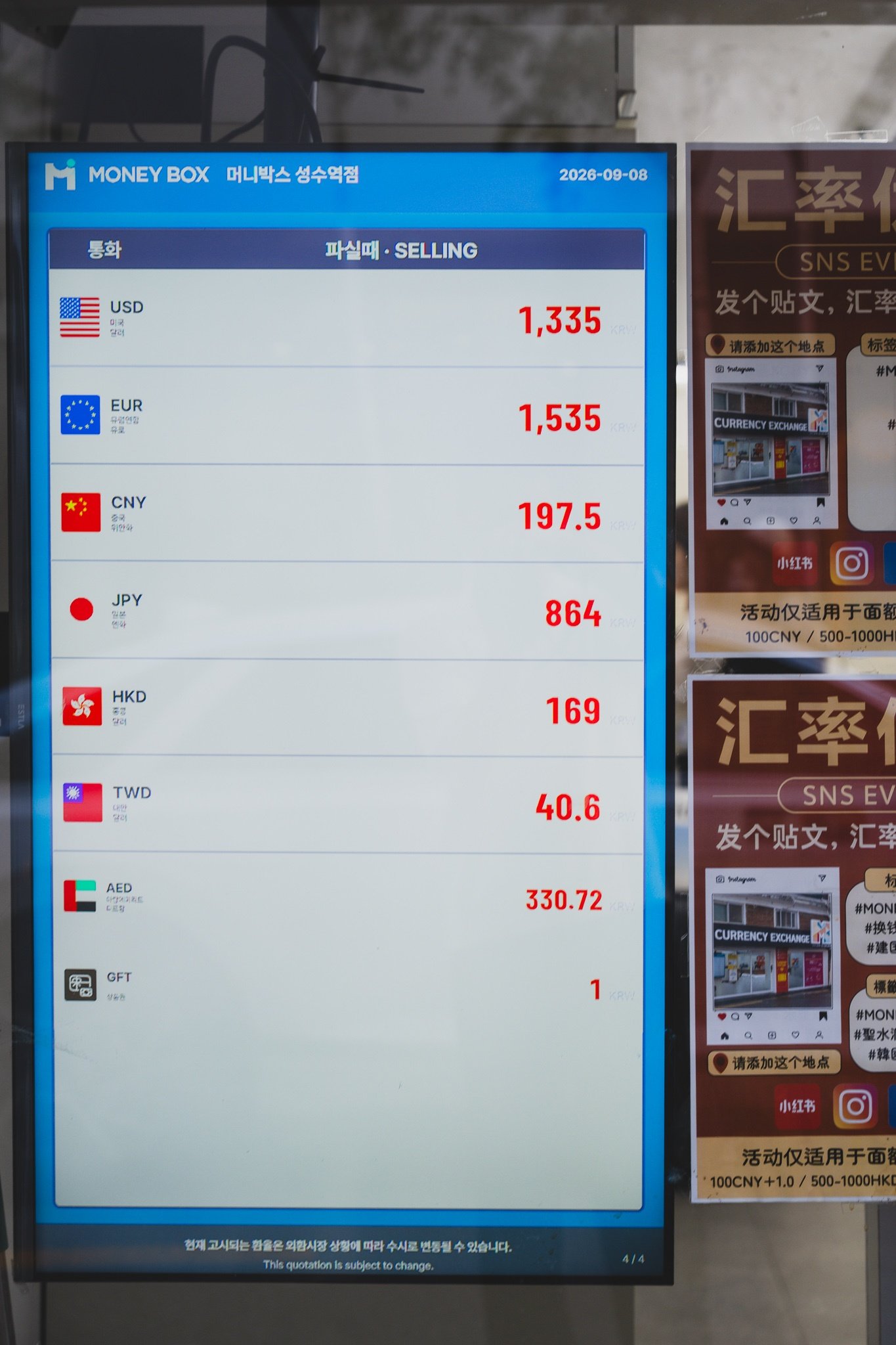
How to read the board — and what a fair rate looks like. The column here is headed 파실때 · SELLING, which means when you sell — you are the one selling foreign currency, so this is the number you get for handing over your dollars. (Boards that also show a 살때 / BUYING column are quoting the opposite direction: what you’d pay in won to buy foreign cash.)
On September 8, 2026, this board read 1,335 KRW per USD. The mid-market rate that day was 1,342.87, so the shop was keeping about 7.9 won per dollar — roughly 0.6%. Put that in trip terms: exchanging $500 here gets you ₩667,500, against ₩671,435 at the theoretical perfect rate. You lose about ₩3,900. Do the same $500 at an airport counter running 3–5% worse and you lose ₩20,000–34,000 instead. That single decision is worth more than most people’s daily coffee budget in Seoul.
Two things to note about the board. The rates move during the day, and the fine print says so outright (“This quotation is subject to change”), so a board photo is a snapshot, not a promise. And the Japanese yen line is quoted per 100 JPY, not per 1 — 864 means ₩864 for ¥100, which is the standard convention on Korean boards and catches people out.
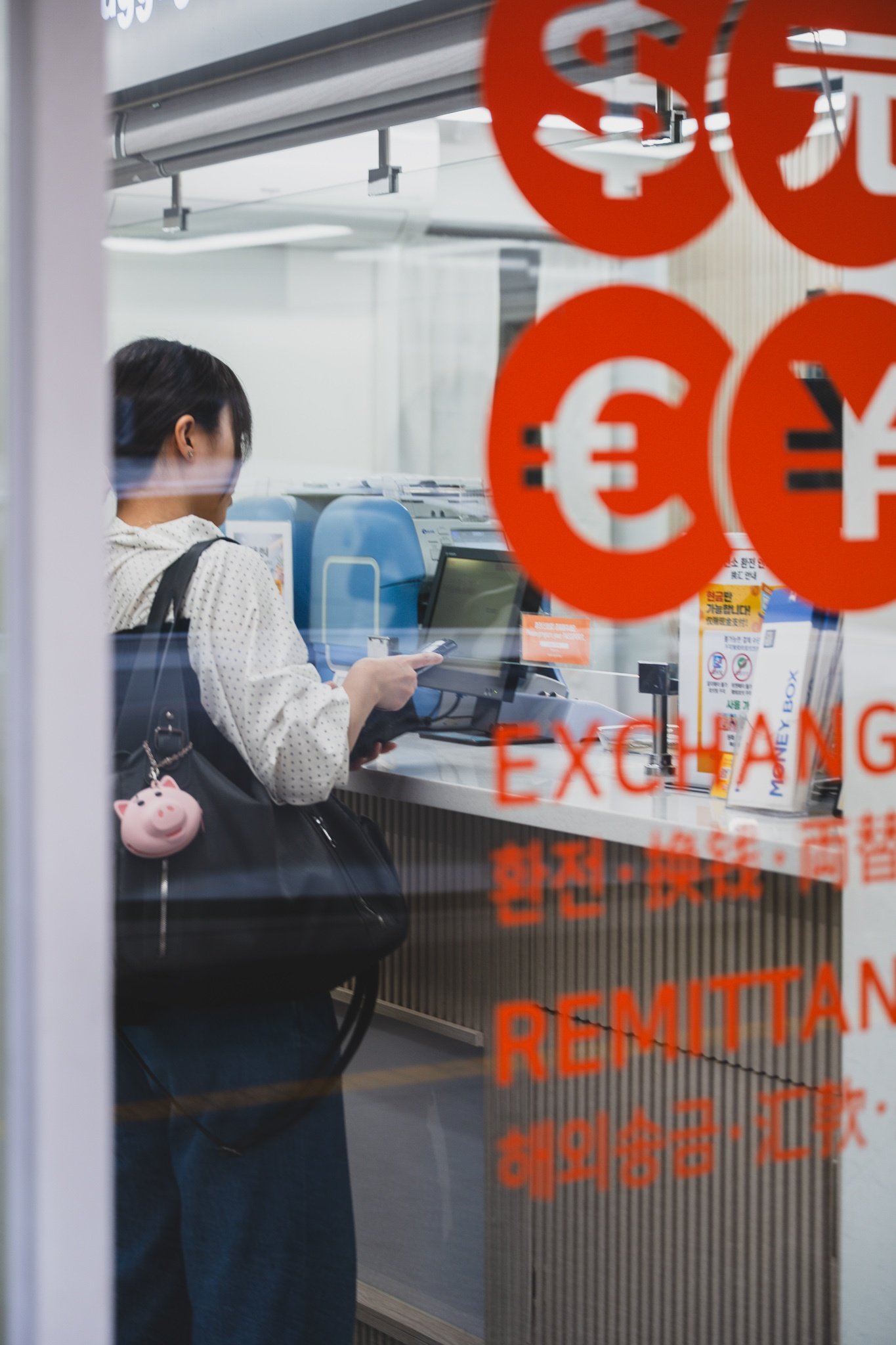
What actually happens at the counter. It’s a five-minute transaction. You bring your passport — Korean exchange shops are required to record ID, so a photo on your phone or a hotel keycard won’t do — hand over your cash, and the teller counts it, runs the amount at the posted rate, and counts the won back to you in front of you. Bring clean, unfolded bills; badly damaged notes sometimes get refused or discounted. And bring cash for the currency you’re exchanging: these counters take physical notes, not cards. Count what you get back before you leave the window, which is standard practice everywhere and nobody finds it rude.
One small trick visible on the window posters: this branch (and many others) runs an SNS promotion — post about the shop with their hashtags and you get a slightly better “preferential rate.” It’s a couple of won per dollar, so it’s worth exactly as much effort as it sounds, but it’s free if you’re already going to post.
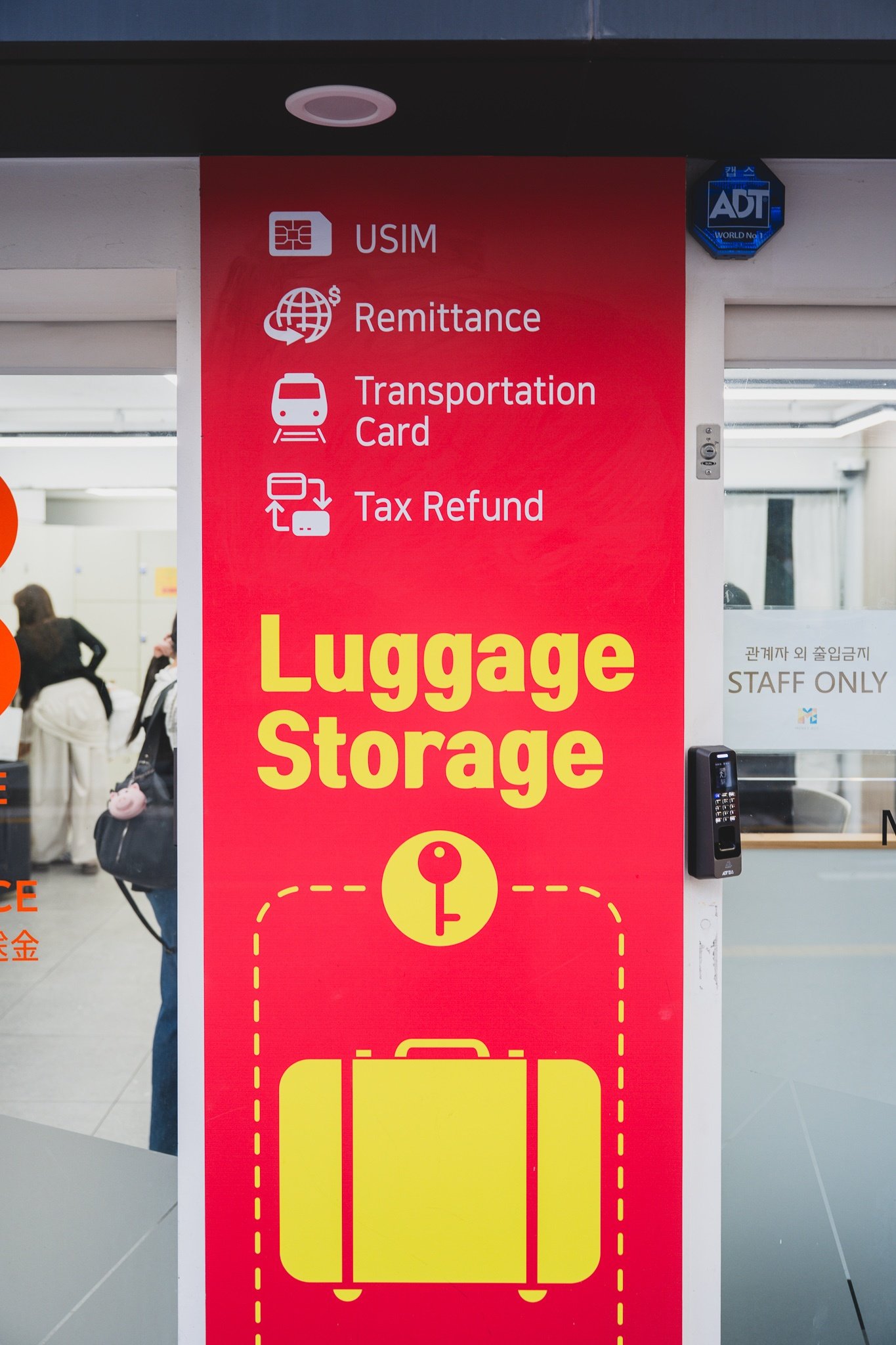
These shops do more than exchange money. This is the part that genuinely surprised me and is worth planning around. The same counter also sells USIM cards, handles overseas remittance, sells and charges T-money transportation cards, processes tax refunds, and runs luggage storage lockers. If you’ve checked out of your accommodation and have a full day in Seoul before a night flight, an exchange shop near a subway station is one errand stop that clears four items off your list at once — bags dropped, cash in hand, SIM sorted, transit card topped up.
Where to go: Myeongdong, or wherever you already are. The private money changers clustered around Myeongdong Station (Exit 5 in particular) are the classic recommendation, and deservedly so — they skip the bank discount system entirely and post competitive street-level rates, typically beating bank branch rates by 2–3%, and banks themselves are usually about 30 won per dollar better than the airport. But the point of the Seongsu board above is that you no longer have to make a special trip to Myeongdong to get a rate in that range. Seoul’s tourist neighborhoods — Seongsu, Hongdae, Gangnam, Insadong, Dongdaemun — all have registered exchange shops posting comparable numbers now. If you’re already spending an afternoon in Seongsu-dong’s cafe and bakery district, exchange there and skip the extra subway ride.
Skip the airport for anything beyond your first taxi ride. Incheon Airport’s exchange counters typically run 3–5% worse than the mid-market rate, which on a $500 exchange can mean losing 20,000–35,000 KRW compared to a better option downtown. It’s fine for a small amount to cover your first transport and meal — 50–100 USD is usually enough — but don’t change your whole trip’s cash budget there. If you’re arriving via Incheon, our guide to getting from the airport to Seoul covers how to get downtown quickly so you’re not stuck relying on airport rates any longer than necessary.
A couple of practical notes: exchange rates tend to be most stable on weekdays before 5 PM, and it’s worth comparing two or three shops on the same street before committing — in a dense area like Myeongdong they’re close enough together that this only costs you a few minutes. Check the rate against the live mid-market number on your phone (search “USD to KRW”) before you hand anything over; if the gap is under 1%, that’s a good rate and you’re done shopping around.
Method 3: ATM Withdrawals
Pulling cash directly from an ATM with your home debit or credit card works in Korea, but it’s the option where fees quietly add up the fastest.
Korean-side fees: Most banks charge foreign cards ₩3,000–4,500 per withdrawal. Woori Bank tends to be on the cheaper end at around ₩2,000–3,000, and convenience store ATMs (CU, GS25, 7-Eleven, Emart24 — all open 24 hours and everywhere) run roughly ₩3,000–3,600. Citibank Korea is a notable exception: it waives its own withdrawal fee entirely, though branches are mostly concentrated in central areas like Myeongdong, Gangnam, and Jongno.
Your home bank’s fees: On top of the Korean-side fee, your own bank will likely add a flat international ATM fee and/or a 1–3% foreign transaction markup — unless you specifically have a fee-free travel debit card (Wise, Charles Schwab, and similar are popular for this reason among frequent travelers).
Watch for the DCC trap: When you insert your card, some ATMs will ask if you want to withdraw in your home currency instead of KRW — this is Dynamic Currency Conversion (DCC), and it almost always applies a worse exchange rate than letting your own bank do the conversion. Always choose KRW / Local Currency when prompted.
Withdrawal limits: Expect a per-transaction cap somewhere between ₩400,000 and ₩1,000,000, depending on the bank and machine.
Quick Comparison
| Travel Card | Neighborhood Exchange Shop | ATM | |
|---|---|---|---|
| Rate quality | Near mid-market | ~0.6% off mid-market (measured, Seongsu, Sept 8 2026) | Decent, minus fees |
| Fees | ~0% on major currencies | None (built into the rate) | ₩2,000–4,500 + your bank’s fee |
| Convenience | Tap to pay + transit (WOWPASS) | Walk-in, ~5 min, passport required | ATMs everywhere |
| Extras | — | USIM, T-money, tax refund, luggage storage | — |
| Best for | Everyday spending | Bulk cash for cash-only spots | Emergency cash top-ups |
Which One Should You Actually Use?
Realistically, most travelers end up combining two of these rather than picking just one:
- Set up a travel card (Travel Wallet, Traveloger, or WOWPASS) before you fly — this becomes your main way to pay almost everywhere, at a rate you don’t have to think about.
- Exchange a modest amount of cash at a neighborhood shop for the cash-only spots — some traditional markets, small street food stalls, and older guesthouses. Do it in whichever district you’re already visiting rather than making a dedicated trip.
- Keep ATM withdrawals as a backup, not your main plan, since the per-transaction fees make it the most expensive way to get small amounts of cash repeatedly.
Bonus: What About Mobile Payments?
If you’re used to tapping your phone for everything at home, it’s worth knowing Korea’s mobile payment landscape doesn’t quite work the way you’d expect.
Apple Pay launched in Korea in December 2023 with Hyundai Card, but as of 2026 it’s only usable at roughly 10% of merchants — Korea’s payment terminals were built around a domestic card network (the VAN system) that was never designed for NFC contactless, so most machines simply can’t read it. The 10% that do support it tend to be the places tourists spend the most time anyway — convenience stores, major café chains, department stores, and large supermarkets — but budget restaurants with ordering kiosks are a common failure point, where a foreign-linked Apple Pay transaction gets rejected even if the kiosk shows an NFC symbol. One genuinely useful update: since April 2026, Mastercard holders can tap directly on Seoul Metro gates with Apple Pay.
Samsung Pay actually covers more ground than Apple Pay in Korea, because it uses MST (Magnetic Secure Transmission) in addition to NFC — meaning it works on the older swipe-style terminals that are everywhere. The catch for tourists is registration: Samsung restricts some features by region, and not every foreign-issued card registers cleanly, so don’t assume your home-country Samsung Pay setup will just work once you land.
Alipay and WeChat Pay are both part of the Alipay+ network, which is also linked to Korean apps like Kakao Pay, and they’re accepted at a wide range of spots — K-beauty stores, convenience chains, traditional markets, and shopping malls. In practice, though, this infrastructure is built for Chinese tourists who already have these accounts; most Western travelers don’t have an Alipay or WeChat Pay wallet set up, so it’s rarely a practical option unless you’re already using one for a China trip. (As of late 2025, Japan’s PayPay was also added to the Alipay+ network in Korea, so this cross-border QR payment web keeps expanding.)
The practical takeaway: don’t plan around mobile payments as your primary method in Korea. Treat a travel card (see Method 1 above) as your main way to pay, and think of mobile payments as a nice-to-have that works often enough to be convenient, but not consistently enough to rely on.
FAQ
Q: Is Korea a cash-heavy or card-heavy country?
A: Overwhelmingly card- and app-heavy. You can go most of a trip barely touching cash, but keep some on hand for smaller traditional markets and a handful of older, family-run spots.
Q: Do I need my passport to exchange money?
A: Yes. Korean exchange shops are legally required to record ID for currency transactions, so bring your physical passport — a photo of it usually won’t be accepted.
Q: The board says “파실때 / SELLING.” Is that the rate I get or the rate I pay?
A: That’s the rate you get. “파실때” means when you sell, and you’re the one selling foreign currency for won. A “살때 / BUYING” column, if shown, is the reverse — what you’d pay in won to buy foreign cash before flying out.
Q: How do I know if the rate on the board is any good?
A: Search “USD to KRW” on your phone to get the live mid-market rate and compare. Under about 1% below mid-market is a good rate — the Seongsu shop I photographed was at 0.6%. Airport counters typically sit 3–5% below.
Q: Why is the yen rate on the board so high?
A: Japanese yen is quoted per 100 JPY on Korean boards, not per 1. A board reading 864 means ₩864 for ¥100.
Q: Can I just use my regular debit or credit card everywhere instead of getting a travel card?
A: You can, but unless it’s specifically a no-foreign-transaction-fee card, you’ll likely pay a 1–3% markup on every single purchase — a travel card avoids that.
Q: Do I need Korean won before I land, or can I sort it out at the airport?
A: You don’t need won in advance. Incheon Airport has 24-hour exchange counters and ATMs, so it’s fine to land with none — just don’t exchange more than you need for the first day or two there.
Q: What’s the minimum I should carry in cash?
A: Enough for one taxi ride, one meal, and a bit of a buffer — 50,000–100,000 KRW covers most people’s first day comfortably.
Q: Are WOWPASS and Travel Wallet the same thing?
A: No — Travel Wallet and Traveloger are purely prepaid currency cards. WOWPASS does that plus doubles as a T-money transit card, so it’s worth considering if you want one card for both payments and public transport.
Q: Can I just use Apple Pay or Samsung Pay instead of a travel card?
A: Not reliably. Apple Pay only works at around 10% of Korean merchants due to limited NFC terminal support, and Samsung Pay’s foreign-card registration can be inconsistent. Bring a travel card as your main payment method and treat mobile payments as a backup.
Bottom Line
Don’t overthink this one: get a travel card set up before you fly, exchange a small amount of cash at a neighborhood money changer once you’re in Seoul, and treat ATMs as a backup rather than your main plan. You don’t need to hunt for a legendary rate — as the Seongsu board shows, an ordinary registered shop on an ordinary street was within 0.6% of the real rate. Just don’t do it at the airport, and you’ve already captured most of the savings available.
This post may contain affiliate links. If you book through them, we may earn a small commission at no extra cost to you.