TL;DR: You don’t need to tip in Korea — not at restaurants, taxis, hotels, or salons. Prices already include service, staff are paid a fixed wage, and tipping can occasionally be seen as awkward or even rude. The one exception: some upscale restaurants and hotels add a service charge (봉사료, bongsaryo) of around 10% automatically — if that’s already on your bill, there’s nothing more to add.
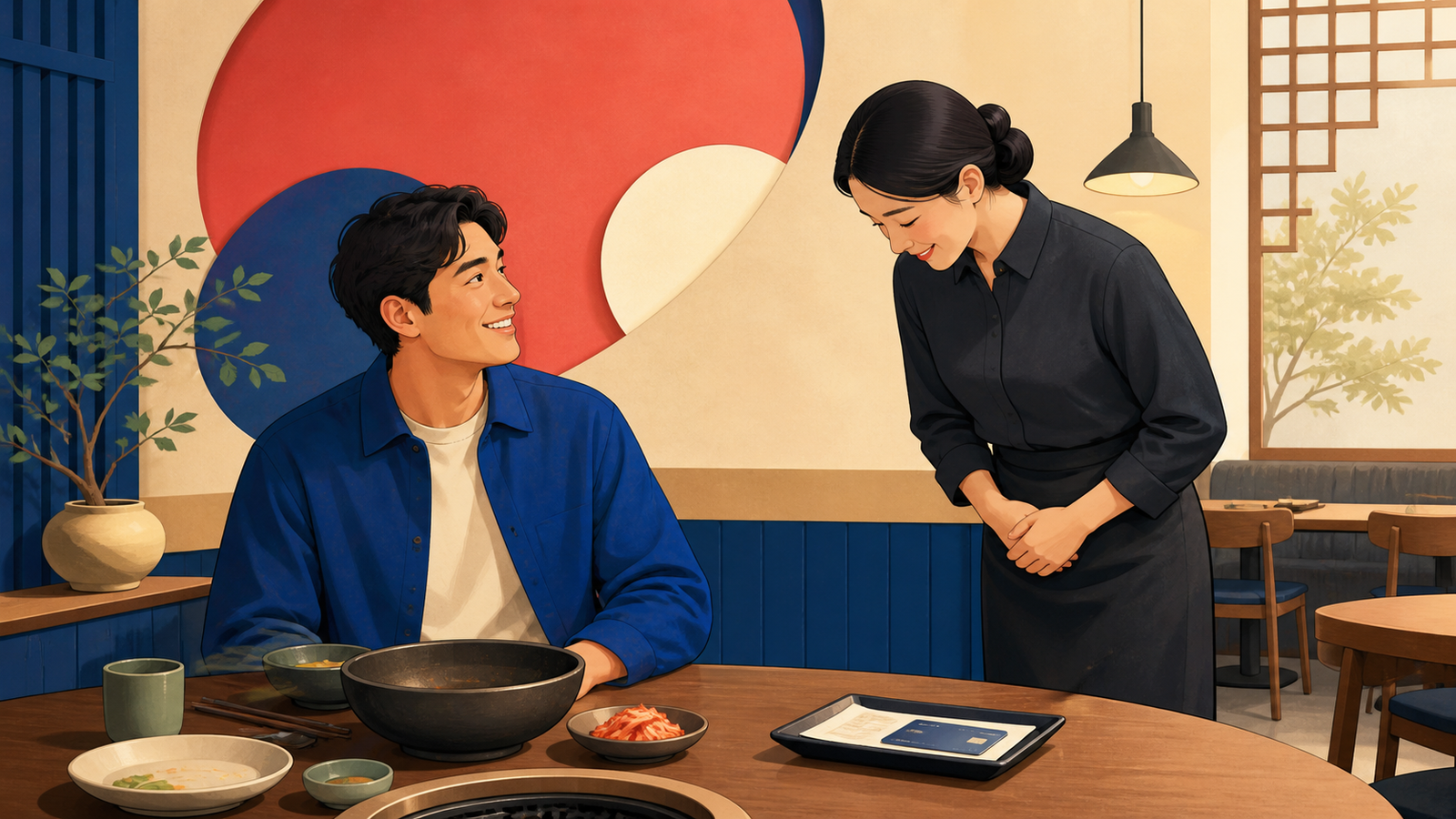
This is one of those small cultural gaps that trips up a lot of first-time visitors, mostly because it runs opposite to habits from home. In Korea, the price on the menu is the price you pay, full stop.
Restaurants: never tip
This applies at every price point — a 3,000 KRW kimbap shop and a 200,000 KRW-per-person fine dining spot in Gangnam follow the same rule. Some upscale restaurants and hotel restaurants do add a service charge automatically, usually shown as 봉사료 (bongsaryo) at around 10% of the bill. If you see that line item, it’s already covering what a tip would elsewhere — don’t add anything on top.
Taxis: pay the meter, that’s it
Just tap your card or pay cash for the exact fare shown on the meter. If the total comes out to something like 9,800 KRW, rounding up to 10,000 is common — but that’s convenience, not a tip, and drivers won’t expect anything more.
Hotels: the one gray area
This is really the only place where a small gesture can happen. If a concierge goes genuinely out of their way — sorting out a complicated booking issue, tracking down something hard to find — a discreet cash gift in an envelope (roughly 10,000–20,000 KRW) can be a thoughtful way to say thanks. It’s not expected, and standard housekeeping or bellhop service doesn’t call for anything at all.
Why tipping can actually feel awkward here
Korean service workers are paid a fixed wage that doesn’t depend on tips, so the whole framework of “tip for good service” doesn’t really exist in the culture. Offering a tip can sometimes be met with genuine confusion, a polite refusal, or in some cases mild offense — as if you’re implying they weren’t already doing their job properly. If you do want to leave something (say, at a small family-run restaurant you loved), keep it low-key rather than making a show of it.
FAQ
Q: What if I really want to show appreciation for great service?
A: A sincere thank-you goes a long way here — verbally, or even a short note. Money isn’t the default way to express that in Korea.
Q: Will a taxi driver or waiter get upset if I try to tip?
A: Usually not upset, but often confused or quick to refuse. Don’t be surprised if cash is politely pushed back toward you.
Q: Is a service charge the same as a tip?
A: Not exactly — a service charge (bongsaryo) is a set percentage automatically added to the bill at some upscale venues. It functions similarly to a tip in that it covers service, but it’s not optional or additional like a Western-style tip.
Q: Do delivery drivers expect tips?
A: No — food delivery in Korea doesn’t run on a tipping model either. The delivery fee (if any) is already built into the order.
Q: Are there any service industries in Korea where tipping is more common?
A: Not really — the no-tipping norm holds fairly consistently across restaurants, cafes, taxis, salons, and hotels.
Bottom Line
One of the easiest things to get right in Korea: don’t tip. Enjoy not having to do the mental math on 15-20% every time you eat out, and save any real gratitude for a sincere thank-you instead of cash.