TL;DR: Itaewon is the center of gravity for both — the streets around Seoul Central Mosque hold the densest cluster of halal restaurants in the country (Turkish, Pakistani, Lebanese, Malaysian, Indonesian, and halal Korean kitchens all within a 10-minute walk), and the same neighborhood has a solid concentration of dedicated vegan cafes. If you want halal Korean food specifically, EID Halal Korean Food and Makan (run by Korean-Muslim families, both KMF-certified) are two of the few certified options in the country.
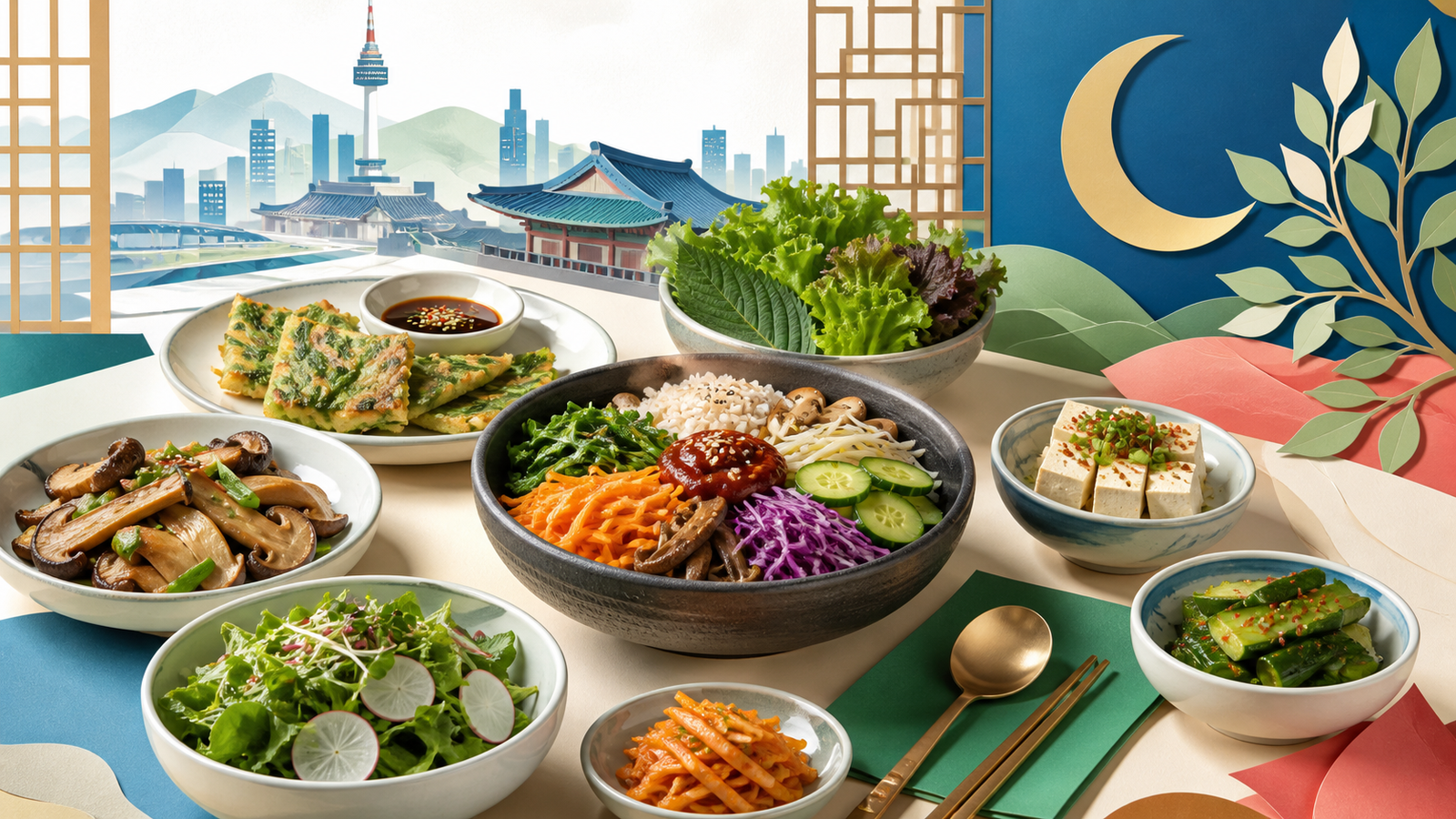
This is a real gap in mainstream Korean dining — most traditional dishes use fish sauce, pork stock, or meat as a base even when they look plant-based, and halal certification is still relatively rare outside a few specific neighborhoods. Knowing where to go in advance saves a lot of frustration.
For halal food: Itaewon, specifically near the mosque
Seoul Central Mosque anchors the whole scene. The two narrow streets climbing up toward it hold the country’s densest cluster of halal and Middle Eastern kitchens — within a 10-minute walk you’ll find Turkish, Pakistani, Lebanese, Egyptian, Malaysian, Indonesian, Uzbek, and even halal Korean restaurants side by side.
If you specifically want halal versions of Korean dishes rather than international halal food:
– EID Halal Korean Food — run by a Korean-Muslim family, one of the few KMF-certified Korean kitchens in the country.
– Makan Halal Korean Restaurant — about 150 meters from EID, with mains typically around 10,000 KRW, making it one of the more affordable halal Korean options.
Outside this cluster, halal certification thins out fast, so it’s worth planning meals around this neighborhood if halal is a hard requirement rather than assuming you’ll find something wherever you happen to be.
For vegetarian and vegan food
Itaewon covers this too, with a handful of dedicated vegan cafes in the same general area — think salads, wraps, veggie burgers, lentil bowls, and pasta, plus at least one vegan bakery-cafe doing wood-fired bread and brunch sandwiches. Beyond Itaewon, Seoul’s vegan restaurant scene has grown enough that dedicated directories (HappyCow being the most useful one to have on your phone) list dozens of options across different neighborhoods.
One option that covers both bases: Loving Hut, a global vegan chain with locations in Seoul, has some branches that are also halal-certified — useful if you’re navigating both restrictions at once.
Navigating regular Korean restaurants
If you’re not sticking to Itaewon for every meal, a few practical notes:
– Many Korean dishes that look vegetarian (kimchi, some banchan side dishes) are often made with fish sauce or shrimp paste as a base seasoning — don’t assume a dish is meat-free just because it looks like vegetables.
– Bibimbap without meat, and simply asking for “no meat” (고기 빼주세요, gogi ppae-ju-seyo), is one of the more reliably adaptable dishes at a standard Korean restaurant.
– A translation app with camera mode (see our apps guide) is genuinely useful here for reading ingredient lists you can’t otherwise verify.
FAQ
Q: Is it hard to find vegetarian food outside Itaewon?
A: It’s more effort than in cities with a bigger vegetarian dining culture, but not impossible — bibimbap, certain temple food restaurants, and a growing number of dedicated vegan spots exist across Seoul; just don’t expect every neighborhood to have obvious options.
Q: Are Buddhist temple food restaurants a good option for vegetarians?
A: Yes — traditional Korean temple cuisine (사찰음식, sachal-eumsik) is plant-based by religious practice and worth seeking out specifically if you want an authentic vegetarian Korean meal.
Q: How reliable is halal certification in Korea?
A: Look for KMF (Korea Muslim Federation) certification specifically — it’s the standard certifying body, and restaurants that have it will usually display it visibly.
Q: Can I get halal Korean BBQ?
A: It exists but is limited — Itaewon is your best bet for finding it, since certified halal Korean kitchens outside that area are uncommon.
Q: Is there a good app or website for finding vegan spots citywide?
A: HappyCow is the most commonly used directory for vegan and vegetarian restaurants and is regularly updated with Seoul listings.
Bottom Line
If either dietary need is non-negotiable for you, build at least one or two meals around Itaewon’s mosque-adjacent cluster — it’s the most concentrated, reliable option in the city. Elsewhere, a translation app and a bit of Korean (“no meat”) go a long way at regular restaurants.