TL;DR: Most fast-casual chains use touchscreen kiosks with an English option (look for a flag icon or “English” button) — nearly 13% of Korean restaurants now use unmanned ordering, up from 4.5% just a few years ago. At sit-down places, look for a call button on the table to summon staff, and don’t hesitate to point at a photo menu, a plastic food display, or another table’s dish. Papago’s camera translation covers anything printed that isn’t already in English.
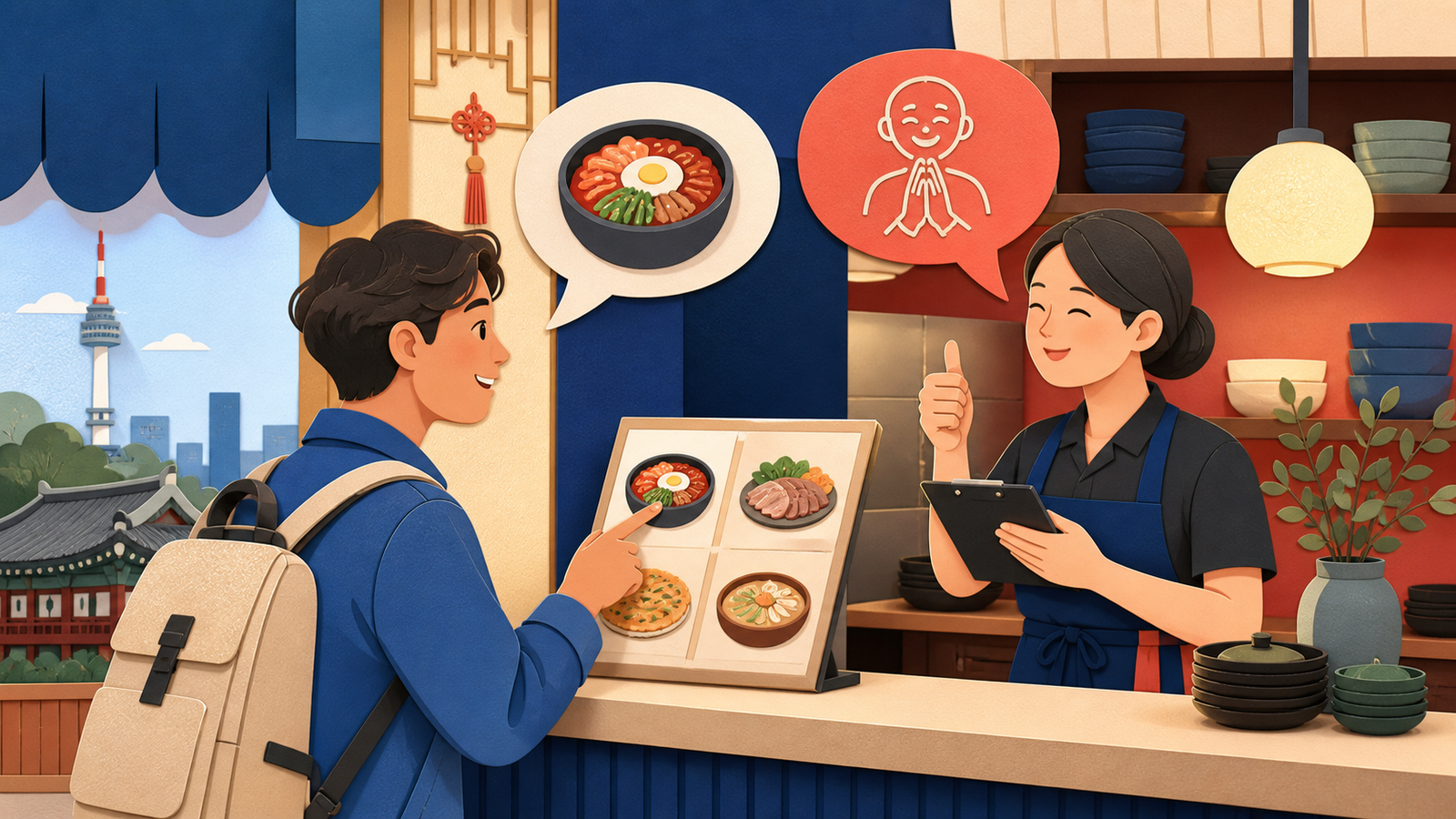
Ordering food is one of those things that sounds intimidating before a Korea trip and turns out to be almost a non-issue once you’re actually there — mostly because the systems are built to need less conversation than you’d expect.
Kiosks: the language-free option
A growing share of restaurants — especially fast-casual and franchise spots like McDonald’s, Lotteria, and Burger King — use self-order kiosks instead of counter staff. Most of these have full English support: look for a small flag icon or an “English” button, usually in a corner of the opening screen. Once you’re in English mode, the whole process (item selection, customization, payment) reads clearly, and you never have to say a word out loud.
Sit-down restaurants: a few different systems
Korean restaurants ordering setups vary by type:
– Fast casual: order and pay at the counter first, then sit down and wait for your number to be called.
– Traditional sit-down places: a server takes your order at the table, or you order via a tablet built into the table, or a kiosk near the entrance.
– Getting a server’s attention: look for a small call button on the wall or table — press it once, and staff will come to you. No need to wave anyone down or call out.
When there’s no English menu
Plenty of restaurants in tourist-heavy areas have at least partial English menus, but not all of them will. When you hit a Korean-only menu:
– Look for photos — many menus include them, and pointing works perfectly well as an order.
– Check for a plastic food display case near the entrance, common at many restaurants, and point at what looks good.
– If a nearby table has something that looks great, pointing at their dish and gesturing “that one” is a completely normal way to order in Korea.
– Use a camera-translation app (Papago’s real-time overlay mode works well for this — see our apps guide) to read a printed menu on the spot.
Payment
Card payment is standard almost everywhere, and as of 2026, Apple Pay and Google Pay work at most major franchises and convenience stores too. And a reminder that’s easy to forget if you’re used to a different system: you don’t tip in Korea — the price on the menu or kiosk screen is exactly what you pay.
A handful of phrases that cover most situations
You genuinely don’t need more than a few phrases to get by:
– “이거 주세요” (i-geo ju-se-yo) — “This one, please” (while pointing)
– “포장이요” (po-jang-i-yo) — “To go, please”
– “여기서 먹을게요” (yeo-gi-seo meo-geul-ge-yo) — “For here, please”
Combined with pointing and a translation app for anything unclear, that’s usually enough to order confidently anywhere.
FAQ
Q: What if the kiosk doesn’t have an English option?
A: Point your phone’s camera at the screen using a translation app, or simply point at menu photos — most kiosks show images alongside Korean text.
Q: Do servers expect you to speak Korean?
A: No — staff in tourist areas are generally used to foreign visitors and patient with pointing, gestures, and translation apps.
Q: Are there food delivery apps that work for tourists?
A: Yes — some delivery apps offer English interfaces, though setup (payment, address) can be more complex than in-person ordering, so it’s usually simpler to eat in or order at the counter as a visitor.
Q: What if I have dietary restrictions and can’t read the menu?
A: A camera translation app is especially useful here — translate the full menu or ask staff directly using a translated phrase like “no [ingredient], please.”
Q: Is it rude to point at food instead of naming it?
A: Not at all — pointing at a photo, display, or another table’s dish is a completely normal and expected way to order in Korea.
Bottom Line
Between English-language kiosks, photo menus, call buttons, and a translation app in your pocket, ordering food in Korea without Korean is far easier than it sounds — plan on pointing more than talking, and you’ll be fine.